
Plastic Pallets with Cup Feet, 3 Legs, 9 Legs, Cross Base: Differences and Which to Choose
📅 Oct 12, 2026
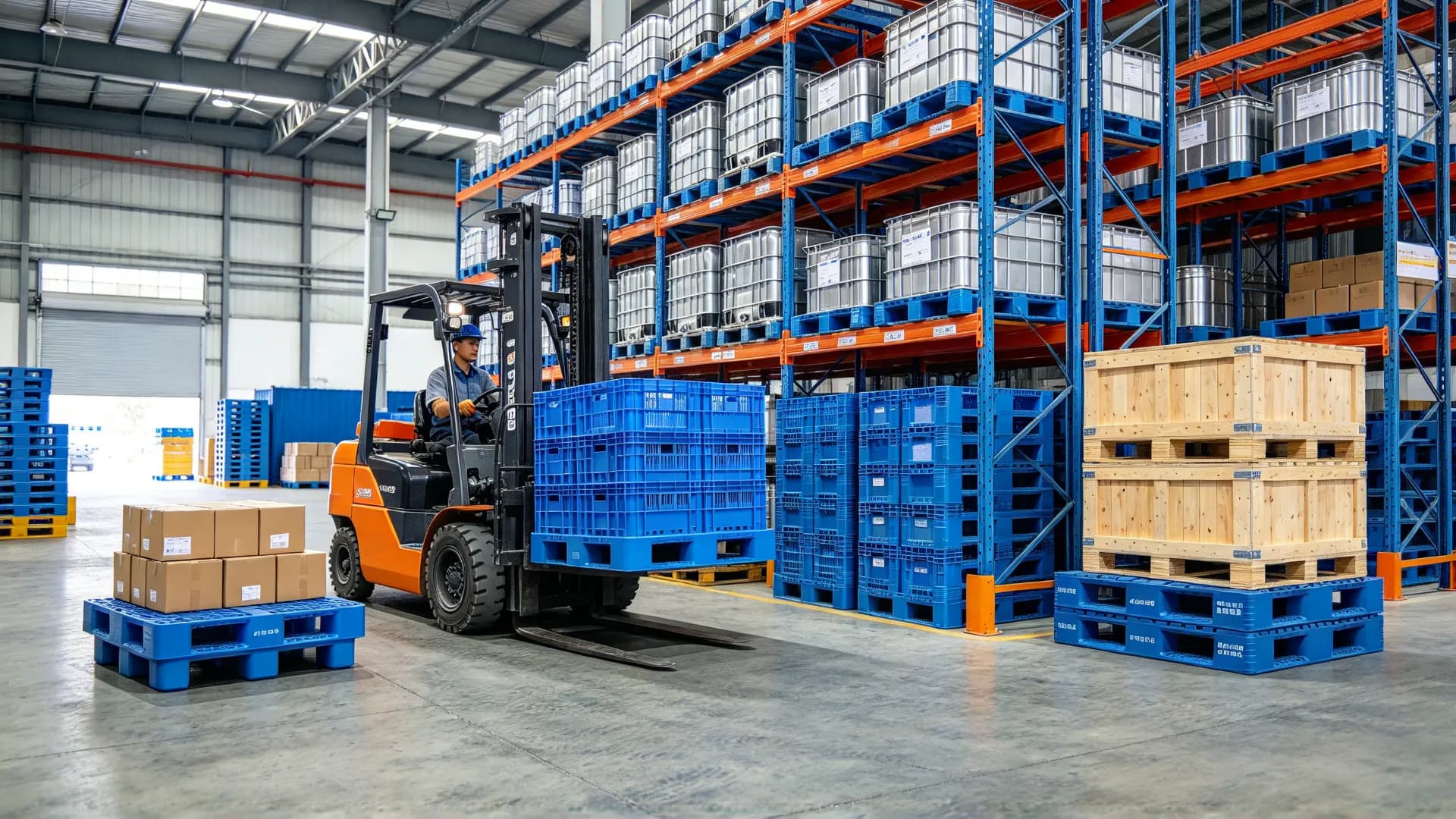
When purchasing plastic pallets, most buyers only mention two things: dimensions and load capacity. However, two pallets both sized 1200 x 800 mm with grid tops can be used very differently in the warehouse. One allows forklift forks to enter from four directions, the other does not. One stacks when empty, the other does not fit well when stacked.
The difference lies in the base. There are four common base types: cup feet, 3 legs, 9 legs, and cross base. The base determines how many directions the forklift can enter, whether the pallet can be placed on rack beams or needs reinforcement, and how heavy the pallet is when pulled by hand.
This article compiles the actual specifications of the four base types sold at Minh Quân Plastic, clearly showing their differences, then guides you to choose according to your warehouse tasks.
1. The pallet base is the most overlooked detail
Everyone notices the top: grid top for ventilation, solid top for small items. Few ask about the base because it is not visible from above.
But the base is where the forklift contacts. Cup feet are separate foot blocks evenly distributed under the pallet body, allowing forklift forks to enter from multiple directions. The 3-leg type has legs running along the pallet body, providing higher load capacity. The cross base has a solid cross-shaped bottom, rigid in both directions.
Choosing the wrong base shows consequences in the first week: forklifts must maneuver around each time to pick goods, pallets sag on racks, or the warehouse runs out of space because empty pallets cannot be stacked.
2. Plastic pallet with cup feet: lightest in the group, four-way forklift entry
Plastic pallet with cup feet and grid top has specifications:
Dimensions: 1000 x 1200 x 140 mm
Design: grid top, cup feet, nine cup feet
Material: virgin plastic
Weight: 14.3–15.4 lbs (6.5–7 kg) ±5%
Static load: 2,200 lbs (1,000 kg)
Dynamic load: 1,100 lbs (500 kg)
Color: blue
The clearest advantage is weight. At 14.3–15.4 lbs (6.5–7 kg), one worker can lift it with one hand, pull it without a forklift. Nine cup feet evenly distributed allow forklift forks to enter from all four sides, so drivers do not have to align precisely in narrow aisles.
In return, the dynamic load is only 1,100 lbs (500 kg). When the pallet is lifted and moved, the load on it should not exceed 1,100 lbs (500 kg). This type suits light and medium-weight goods.
If goods can fall through the grid, there is a solid top plastic pallet with cup feet of the same size 1000 x 1200 x 140 mm, made from PP plastic, weighing 19.8 lbs (9 kg) ±5%. The fully solid top prevents powder, plastic pellets, small components, and bottles from falling through. The product page states the load capacity depends on plastic type and stacking method, so when requesting a quote, specify the goods and stacking layers.
3. Plastic pallet with 9 legs: same cup feet family, EUR size
Plastic pallet with 9 legs also uses cup feet but in a different size:
Dimensions: length 1200 x width 800 x height 140 mm
Design: 9 cup feet arranged in 3 rows x 3 columns
Material: PP plastic, virgin or recycled blue or recycled black
Color: blue, black
Condition: 100% new
The 1200 x 800 mm size is EUR size, familiar for export goods and most standard cartons. If your warehouse operates on this size, switching to another size will disrupt stacking standards.
The nine separate cup feet allow forklift forks to enter from four sides. When empty, pallets can be stacked, so returnable pallets do not occupy much space.
One note: because the cup feet are separate, when placed on rack beams, pallets need horizontal supports or liners, not placed directly on two beams with heavy loads. The load capacity of the 9-leg type depends on plastic type and stacking method and is not fixed.
4. Plastic pallet with 3 legs: highest load capacity among the four types
Plastic pallet with 3 legs has specifications:
Dimensions: 1200 x 800 x 150 mm
Design: grid top, with lifting legs
Material: virgin or recycled HDPE plastic
Weight: 29.8–30.9 lbs (13.5–14 kg) ±5%
Static load: 6,610 lbs (3,000 kg)
Dynamic load: 2,200 lbs (1,000 kg)
Color: blue
The static load of 6,610 lbs (3,000 kg) is the highest among the four base types discussed here. The dynamic load of 2,200 lbs (1,000 kg) is also double that of the grid top cup feet type. This type is for heavy goods: raw material bags, tightly packed parcels, high stacking.
The trade-off is weight. At 29.8–30.9 lbs (13.5–14 kg), workers cannot lift it with one hand. Warehouses that frequently move empty pallets by hand should consider this carefully. This type is available in three material grades: virgin blue plastic, recycled blue plastic, and recycled black plastic.
5. Plastic pallet with cross base: solid base, size 1200 x 1000
Plastic pallet with cross base has specifications:
Dimensions: 1200 x 1000 x 150 mm
Design: cross-shaped base
Material: virgin or recycled HDPE plastic
Weight: 26.5 lbs (12 kg) ±5%
Static load: 3,300 lbs (1,500 kg)
Dynamic load: 1,980 lbs (900 kg)
Color: blue
The 1200 x 1000 mm size is 20 cm wider than EUR size horizontally, fitting large cartons, raw material bags, and medium-sized parcels. Many domestic warehouses use this size because it fits common trucks and is not restricted by container sizes.
The dynamic load of 1,980 lbs (900 kg) is intermediate: higher than grid top cup feet, lower than 3-leg type. The weight of 26.5 lbs (12 kg) is also in the middle. This is a balanced type, not the best in any aspect but not weak in any.
Made from HDPE, the pallet is resistant to termites and rot, less affected by moisture, suitable for cold storage, food warehouses, and washing areas.
6. Comparison of the four base types: differences
Load capacity
According to static load on product pages: 3 legs 6,610 lbs (3,000 kg), cross base 3,300 lbs (1,500 kg), grid top cup feet 2,200 lbs (1,000 kg). According to dynamic load: 3 legs 2,200 lbs (1,000 kg), cross base 1,980 lbs (900 kg), grid top cup feet 1,100 lbs (500 kg). The 9-leg and solid top cup feet types report load capacity depending on plastic type and stacking method.
Pallet weight
Grid top cup feet is lightest at 14.3–15.4 lbs (6.5–7 kg). Next is solid top cup feet 19.8 lbs (9 kg), cross base 26.5 lbs (12 kg), then 3 legs 29.8–30.9 lbs (13.5–14 kg). The difference nearly doubles from lightest to heaviest.
Dimensions
EUR size 1200 x 800 mm is available in 3-leg and 9-leg types. Size 1000 x 1200 mm is for grid top and solid top cup feet. Size 1200 x 1000 mm is for cross base.
Forklift entry directions and stacking
Cup feet and 9-leg types allow forklift forks to enter from four sides. The 9-leg type stacks when empty. Separate cup feet require horizontal supports or liners when placed on rack beams.
Top surface
Grid top is on cup feet and 3-leg types: ventilated, light, easy to drain water. Solid top is on solid top cup feet: prevents small items from falling through, easy to clean.
7. Choosing according to warehouse tasks
Warehouse frequently rotates pallets by hand multiple times daily
Choose the light type. Grid top cup feet at 14.3–15.4 lbs (6.5–7 kg) is the clearest choice. Avoid 29.8–30.9 lbs (13.5–14 kg) types that workers struggle with daily, or you will replace them next year.
Heavy goods, high stacking, sometimes placed on racks
Choose 3-leg type with static load 6,610 lbs (3,000 kg) and dynamic load 2,200 lbs (1,000 kg). If placing on racks, send rack photos to technical staff for review, as beam types differ.
Goods packed in EUR size, with export
Choose between the two 1200 x 800 mm types: 3 legs for heavy loads, 9 legs for four-way forklift entry and stacking empty pallets.
Loose goods, small items that can fall through gaps
Choose solid top. Solid top cup feet 1000 x 1200 x 140 mm, PP plastic, 19.8 lbs (9 kg), suitable for powder bags, plastic pellets, small components, bottles, and cartons.
Cold storage, food warehouses, washing areas
Prefer HDPE. Both cross base and 3-leg types have HDPE versions. Grid top cup feet use virgin plastic; product pages also state suitability for cold storage.
Only need to keep goods off the floor, no lifting or moving
No need for pallets with feet. Plastic floor liner pallet without feet, solid top is 35 mm thick, weighs 9.9 lbs (4.5 kg), static load 11,020 lbs (5,000 kg). Product page clearly states this type is not for forklift lifting, so only choose if goods remain stationary.
8. Tips for long-lasting plastic pallet use
First, distinguish static and dynamic load and respect both. Static load applies when pallet rests on flat floor with evenly stacked goods. Dynamic load applies when pallet is lifted and moved. Grid top cup feet list static 2,200 lbs (1,000 kg) but dynamic only 1,100 lbs (500 kg), meaning stacking 1,980 lbs (900 kg) stationary is okay, but lifting and moving is not.
Second, stack goods evenly on the pallet surface. Load specs assume evenly distributed goods. Concentrating all goods in one corner causes pallet cracking fastest, even if total weight is within limits.
Third, prevent forklift forks from hitting the pallet body. Cracks in cup feet often start from off-center impacts, not heavy loads. Train drivers to enter the correct slots.
Fourth, confirm before using rack beams. Separate cup feet cannot rest directly on two beams like solid bases. Without horizontal supports or liners, pallets sag and legs break.
Fifth, wash with water and regular detergent, dry before stacking. HDPE and PP resist water, but stacking when damp causes dirt and slipperiness.
Sixth, choose the right material grade for the task. Virgin blue plastic is for food, pharmaceuticals, and clean surfaces. Recycled blue and black plastics are for general industrial stacking.
9. When these four types are not the right choice
If goods are very light and pallets only keep goods off wet floors without lifting or moving, pallets with feet are unnecessary. Floor liner pallets without feet are lower and lighter, suitable for low-clearance warehouses.
If goods need support in small spaces, there is plastic pallet with feet and perforated top sized 1000 x 600 x 100 mm, HDPE or PP plastic, static load from 2,200–4,400 lbs (1,000–2,000 kg). This small size suits warehouse corners, processing areas, narrow aisles.
If goods exceed dynamic load 2,200 lbs (1,000 kg) even when evenly stacked, do not try to use lighter pallets and increase quantity. See other models in the plastic pallet category to compare sizes and load capacities.
Choosing plastic pallets is not difficult; just specify three things correctly: what goods and weight, how many stacking layers, and whether placing on rack beams. With these three details, you can identify the suitable base type in minutes, avoiding returns and exchanges.
Minh Quân Plastic provides quotes based on your actual warehouse conditions, delivering nationwide. Call 0907 722 345 to discuss your needs; we will advise on base type, dimensions, and material grade. If using rack beams, please send rack photos for technical confirmation before ordering.