
Which Industries Use 1000L IBC Plastic Tanks with Steel Frames
📅 Sep 30, 2026
👁 0 views
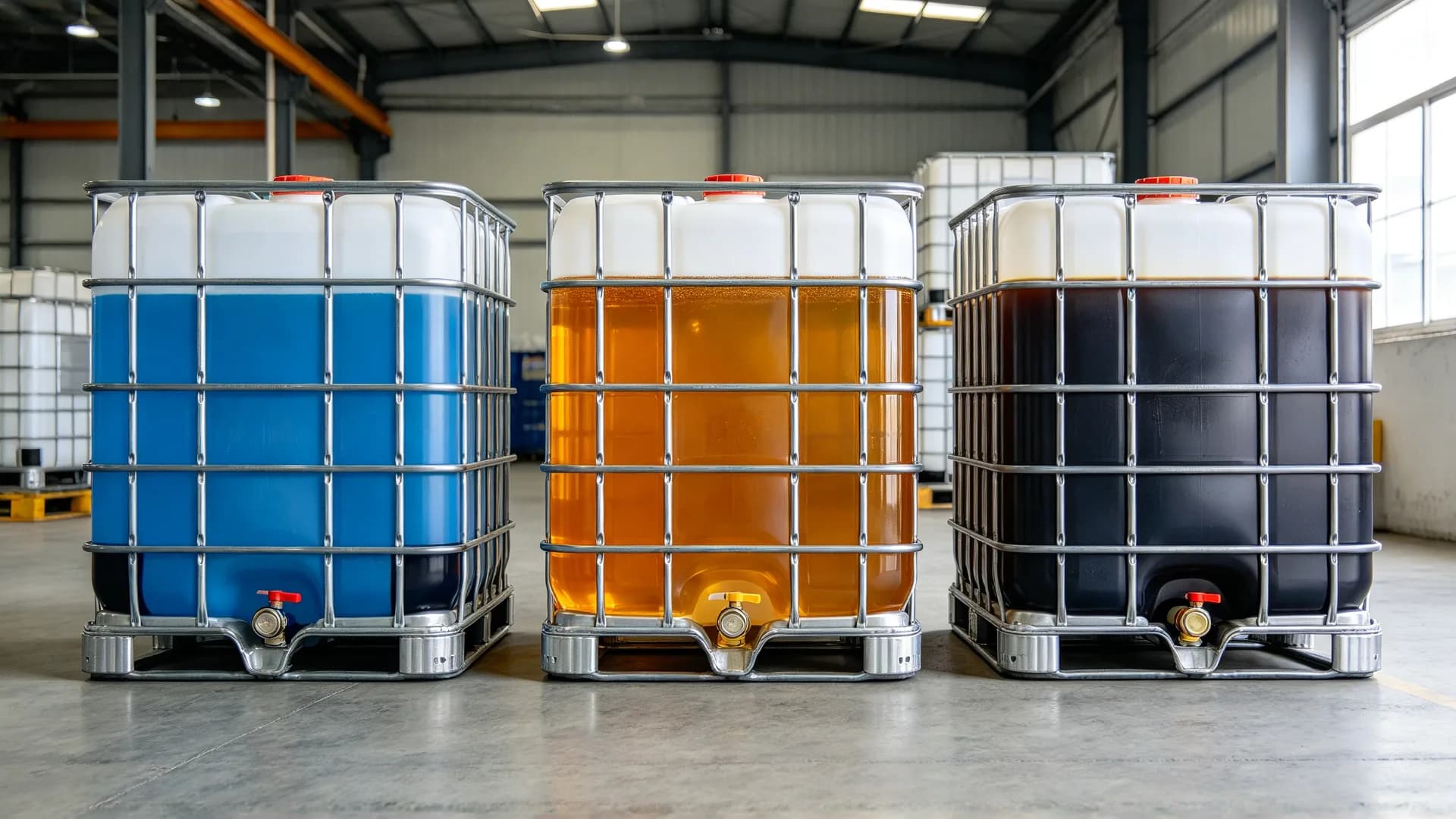
Every warehouse occasionally needs to store more liquid than a single drum can hold. At such times, the commonly mentioned solution is the 1000L IBC plastic tank. One tank replaces five 200-liter drums, features a steel frame and a forklift-compatible pallet base, making it very compact.
However, after purchase, issues often arise. The tank may not fit through the warehouse door. The forklift forks cannot reach the base. Or the stored liquid may not be compatible with the tank. These problems rarely stem from the tank itself. Most often, they result from choosing based solely on the 1000-liter capacity figure without considering your specific industry, the liquid to be stored, and the available space.
This article proceeds in reverse order: examining the tank components, suitable industries, differences compared to drums and regular plastic containers, then selection and usage tips for durability.
1. Components of the 1000L IBC Plastic Tank with Steel Frame
This tank type consists of three parts: an inner plastic tank, an outer steel frame, and a pallet-style base designed for forklift entry.
Specifications of the 1000L IBC plastic tank with steel frame are as follows:
Capacity: 1000 liters
Dimensions: 1200 x 1000 x 1155 mm
Shape: rectangular block plastic tank
Color: translucent white tank, metallic color frame
Packaging: 1 piece per package, unit of measure is piece
Three notable features: a top filling lid for pouring in liquids; a bottom discharge valve that allows flow without tilting or pumping; and a translucent white tank body to visually monitor liquid levels.
The rectangular block shape differs from round drums. Square tanks can be placed tightly together without wedge-shaped gaps, allowing more liters per square meter of floor space.
2. Industries Commonly Using 1000L IBC Tanks
IBC tanks are not tied to any specific industry. They suit any location with three characteristics: large batch liquid usage, multiple daily withdrawals, and availability of forklifts or pallet jacks for movement.
Clean Water and Water Treatment
The most common users because water is not material-sensitive: water storage tanks supplying production lines, mixing tanks, and transfer tanks in treatment areas. The bottom discharge valve facilitates complete drainage during cleaning.
Chemicals and Industrial Solutions
Used in plating workshops, textile dyeing factories, paper mills, and detergent mixing areas. This group requires more caution. The tank specifications do not state the plastic type, so if storing chemicals, confirm the tank material, gaskets, and valve details when requesting a quote, including chemical name, concentration, and storage temperature. Do not assume compatibility based on the tank’s resemblance to water tanks.
Food and Beverage
Facilities using large batches of liquid ingredients such as syrups, concentrates, cooking oils, and soaking solutions. This group also needs to verify tank materials before ordering and keep tanks dedicated to each ingredient type.
Agriculture and Farms
Water tanks for irrigation, nutrient solution mixing tanks, and drinking water tanks for livestock. The pallet base allows moving tanks outdoors and back without pumping. If only water storage without movement is needed, open-mouth round plastic containers in sizes 200L, 250L, 350L, 400L, 750L, 1000L, and 1500L are usually more compact and easier to clean.
Mechanical Workshops, Manufacturing, and Maintenance Areas
Hydraulic oil, cooling fluids, and machine cleaning solvents. This group should place tanks on oil spill containment plastic pallets sized 1300 x 1300 x 300 mm. These pallets have removable grid tops and containment basins below, with a static load capacity of 9,920 lbs (4,500 kg) and dynamic load capacity of 3,300 lbs (1,500 kg), sufficient to support full tanks while keeping the workshop floor dry.
3. Comparing 1000L IBC Tanks with Drums and Regular Plastic Containers
These three groups are often considered side by side when ordering. The difference is not which is better, but how you withdraw the liquid.
1000L IBC Tank
One tank per batch. Top filling, bottom discharge valve, no pumping needed. Holds the most volume per floor position. However, all 1000 liters are in one place; to distribute by area, you must decant.
Plastic Drums
200L plastic drums with sealed lids measure Ø590 x 918 mm high, made from industrial plastic, blue color, with integrated lids featuring filling and discharge openings with screw caps, available in 1-ring, 2-ring, and 3-ring versions. The lid is fixed to the body, reducing loss, suitable when drums must be transported or handled frequently.
For wide-mouth access for scooping, ladling, or cleaning, choose plastic drums with removable lids. These come in various capacities: 30L (310 x 540 mm), 50L (380 x 585 mm), 100L (380 x 760 mm), 120L (430 x 760 mm), 160L (510 x 980 mm), and 200L (580 x 980 mm). Blue body with black lid.
Drums’ strength is in portioning: five 200L drums placed at five machines are more convenient than one 1000L tank in a corner. Their weakness is manual or clamp lifting and occupying more floor space than one IBC tank.
Round and Rectangular Plastic Containers
These two types have open mouths, sealed bottoms, and no valves. Round containers range from 200L to 1500L. Rectangular plastic containers come in 50L, 100L, 200L, 500L, 750L, and 1000L sizes; the 500L version is 132 cm long and 66 cm high, the 750L version is 151 cm long and 72 cm high. Both are blue and made from industrial plastic.
This group suits manual dipping, soaking, washing, or hand retrieval, e.g., soaking raw materials, storing agricultural or aquatic products. Not suitable for sealed storage or valve discharge.
In summary for easy recall: for large batch storage with valve discharge, choose IBC tanks. For portioning by area and sealed storage, choose drums. For manual top-down handling, choose open-mouth containers. All three groups are included in the industrial drums and plastic tanks category.
4. Selection: Five Questions Before Finalizing Your Order
Answering these five questions will almost guarantee the right choice.
What is being stored? Specify the liquid name, concentration, and storage temperature. This is decisive because it determines tank material, gaskets, and valves, not capacity.
How will the liquid be withdrawn? Valve discharge into smaller containers suits tanks. Manual scooping suits open-mouth containers. Pumping to machines requires space for pumps and piping.
How much space is available? Use the 1200 x 1000 x 1155 mm dimensions and measure the placement area, warehouse door, and forklift access. Add clearance on both sides for operator movement.
What equipment will move the tank? Forklifts or pallet jacks enable pallet base use. Without them, a full 1000L tank is effectively stationary; multiple drums are more practical.
How many batches run in parallel? For three or four liquid types simultaneously, order tanks accordingly; do not share tanks and clean between batches.
5. Measure Placement Area Before Ordering
The 1200 x 1000 x 1155 mm dimensions must be checked at four points, from outside to inside.
Warehouse doors and aisles are the first bottlenecks. The tank sits on forklift forks, so total height during movement exceeds 1155 mm. Low doors cause immediate blockage.
The floor placement area must be larger than 1200 x 1000 mm. If placed against a wall, the discharge valve must face outward; otherwise, the tank must be rotated each time liquid is withdrawn.
Above the filling lid, allow clearance to open the lid and insert hoses; do not place directly under beams or pipes. Finally, check the valve height relative to the receiving container below: can the container fit directly or is a riser needed?
6. Filling and Discharging to Minimize Loss
Pour slowly at the start to avoid foaming. Close the lid immediately after pouring, even if more filling is planned during the day, to prevent dust and rain ingress. When discharging, open the valve gradually; opening fully at once risks spilling the container mouth. When nearly empty and flow weakens, raise the rear edge to tilt the tank toward the valve, ensuring complete drainage of the remaining bottom liquid.
The translucent tank body is a built-in monitoring tool. Attach a vertical paper strip on the tank body, marking levels based on actual usage, to know remaining volume without opening the lid. This helps timely reordering and prevents running out mid-shift.
7. Usage Tips for Durability
IBC tanks usually fail not in the tank but in valves and base feet. Small measures extend service life:
Place on a flat surface. Uneven floors cause uneven pallet base loading, leading to cracked feet over time. Using a plastic pallet with sealed cup feet sized 1000 x 1200 x 140 mm levels the placement area; the sealed molded surface distributes load evenly, and nine cup feet allow forklift entry from four directions.
Do not overtighten valves. Valves are the weakest component. Most leaks start from overtightening when the valve stiffens.
Retighten frame bolts after a few months. The steel frame bears the load when full. Loose bolts cause frame distortion, deforming the inner tank.
Avoid prolonged direct sunlight. Tanks left outdoors for months fade and become brittle. Sheltered storage significantly extends lifespan.
If allowable load is unknown, do not stack full tanks. Specifications do not state stacking load capacity; if stacking two layers, inquire first.
Clean immediately after emptying. Dried residues are harder to remove, and deposits in valves cause sticking.
Label the frame permanently. Mark liquid type and filling date. Tanks look alike; mixing causes batch loss.
8. When Not to Choose a 1000L IBC Tank
Consider alternatives in some cases. Warehouses without forklifts or pallet jacks will have full tanks remain stationary throughout their life. Liquids used in very small daily amounts risk quality degradation if stored in large 1000L batches. For multiple daily delivery points, drums are more convenient. For bulk solids, moist goods, or agricultural products, open-mouth containers are better because tanks have only a small top filling lid.
Conversely, if you currently store four or five drums of the same liquid in a warehouse corner and withdraw daily, switching to one IBC tank is almost always neater.
Selecting a 1000L IBC tank is straightforward if done in the correct order: identify the liquid first, confirm tank and valve materials, measure the placement area accurately, then calculate quantity. Doing this in reverse causes most unusable purchases.
Minh Quân Plastic supplies 1000L IBC plastic tanks with steel frames, plastic drums, industrial plastic containers, and plastic pallets, delivering nationwide. If you provide the liquid type, estimated quantity, and placement dimensions, we will advise on the suitable type and send a quote. Call 0907 722 345 for support.