
Industrial Plastic Containers: Distinguishing Round, Rectangular, and Clear Containers
📅 Oct 5, 2026
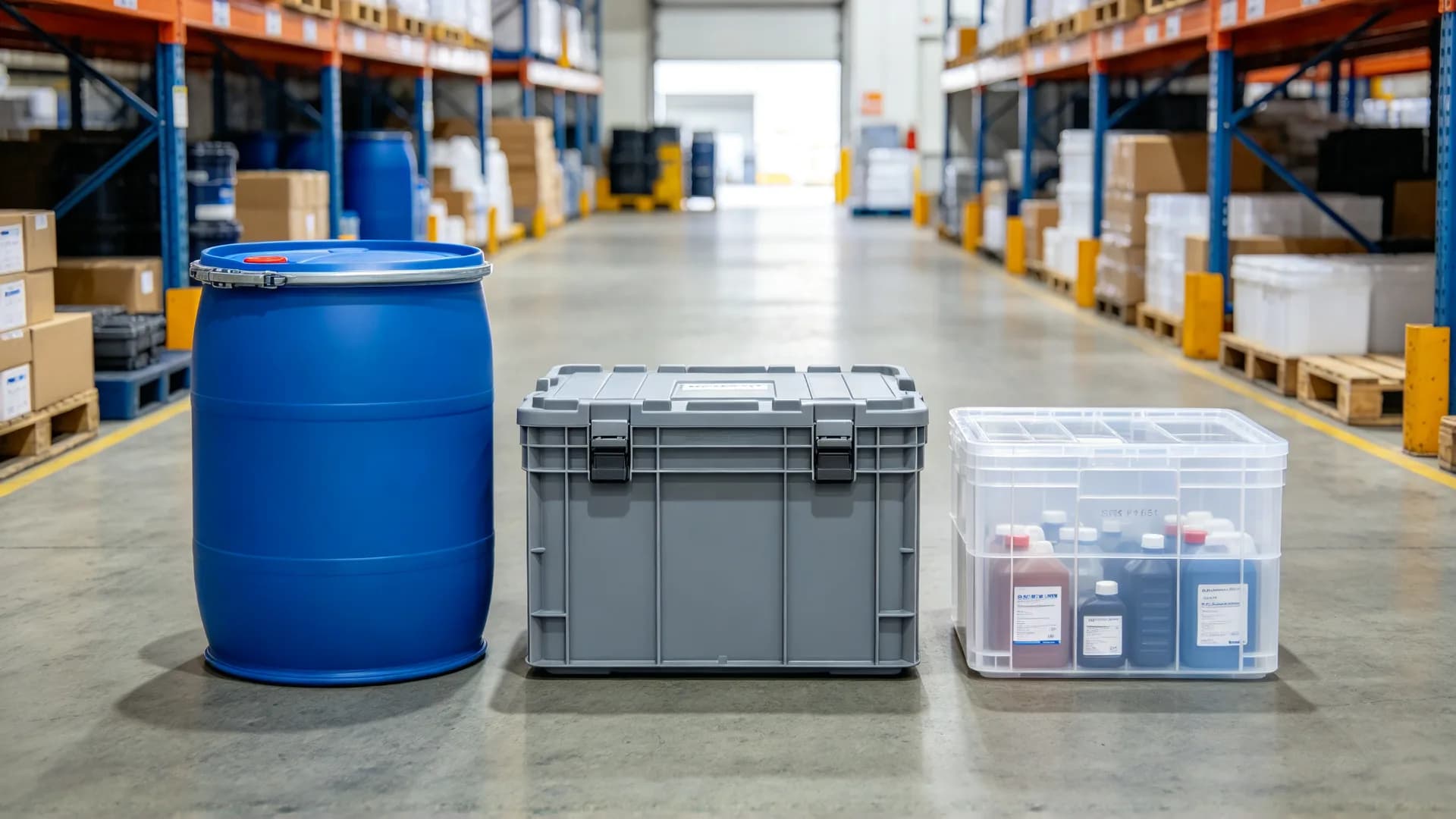
The warehouse needs additional storage containers, but when opening the product catalog, three different types appear: round containers, rectangular containers, and clear containers with lids. All are called industrial plastic containers and used for storage, yet their shapes and capacities vary greatly. Choosing the wrong type means the container can still be used but won’t fit the space, causing fatigue during handling or storing less than needed.
The most common mistake is selecting by capacity while ignoring shape. Two containers both labeled 200 liters, but one is 59 cm high and round, the other 91 cm long and flat. Your warehouse space only fits one of the two. The second mistake is buying sealed containers for goods that require frequent counting, leading to constant opening and closing.
This article clearly separates the three container types, provides actual dimensions for each capacity, and explains how to choose based on product type and placement. After reading, you can finalize the container type and capacity before requesting a quote.
1. What Types of Industrial Plastic Containers Are There?
Within the industrial plastic container category, there are three main types, distinguished by body shape and opening method.
The first type is round containers, open mouth, sealed bottom, one-piece body, blue color. This group has the largest capacities.
The second type is rectangular containers, also open mouth and sealed bottom, also blue, but flatter and longer in shape.
The third type is clear containers with lids. They have transparent white bodies, red side locks, and a cover. This group is significantly smaller than the first two and used differently: for storage where contents are visible without opening the lid.
All three are made from industrial plastic and packaged one piece per unit. Differences lie in shape, capacity, and whether they have lids.
2. Round Plastic Containers: For Water and Bulk Materials
Round plastic containers come in seven capacities: 200L, 250L, 350L, 400L, 750L, 1000L, and 1500L. They have wide openings, sealed bottoms, and one-piece bodies.
Dimensions are measured by mouth diameter, bottom diameter, and height:
200L: mouth 76 cm, bottom 60 cm, height 59 cm
250L: mouth 87 cm, bottom 65 cm, height 60 cm
350L: mouth 97 cm, bottom 75 cm, height 68 cm
400L: mouth 127 cm, bottom 110 cm, height 43 cm
750L: mouth 128 cm, bottom 102 cm, height 77 cm
1000L: mouth 146 cm, bottom 118 cm, height 79 cm
1500L: mouth 172 cm, bottom 144 cm, height 82 cm
Note the 400L size: this container has a 127 cm wide mouth but is only 43 cm high, shorter than the 200L container. It is a flat container designed for soaking or mixing, where workers need to reach the bottom rather than a tall container. If you need to store 400 liters of water but have limited space, this 400L container is unsuitable due to its large footprint.
Round containers are suitable for water, raw materials, agricultural products, and seafood. Their seamless round bodies have no corners, making scooping, pouring, and cleaning the bottom easier.
3. Rectangular Plastic Containers: Utilize Length, Place Against Walls
Rectangular plastic containers come in six sizes: 50L, 100L, 200L, 500L, 750L, and 1000L. They also have open mouths, sealed bottoms, and are blue.
Dimensions are measured by length, height, and bottom:
50L: length 67 cm, height 26 cm, bottom 51 cm
100L: length 85 cm, height 31 cm, bottom 65 cm
200L: length 91 cm, height 41 cm, bottom 76 cm
500L: length 132 cm, height 66 cm, bottom 95 cm
750L: length 151 cm, height 72 cm, bottom 110 cm
1000L: length 215 cm, height 51 cm, bottom 116 cm
Compared to round containers, the rectangular group is lower at the same capacity. The 200L rectangular container is 41 cm high, while the 200L round container is 59 cm high. The lower height allows workers to operate standing without reaching over a tall container wall.
The 1000L rectangular container is 215 cm long. It is almost a long trough used for washing or soaking lines running lengthwise. Before choosing this size, measure the aisle: containers longer than 2 meters cannot turn around in narrow warehouses and are difficult to pass through doors.
Rectangular shapes have an advantage over round ones: they can be placed tightly against walls and next to each other without gaps. In tight spaces, rectangular containers store more liters per area.
4. Clear Plastic Containers with Lids: See Contents Inside
This group is divided into two lines by capacity.
Small line: 15L, 30L, 55L
Small clear plastic containers with lids come in three sizes:
15L: 440 x 310 x 210 mm
30L: 520 x 320 x 275 mm
55L: 610 x 430 x 320 mm
This line is used for components, accessories, office supplies, and small materials. The transparent body allows viewing contents without opening the lid, so inventory checks do not require opening each container.
Large line: 90L, 120L, 140L
Clear plastic containers with lids from 90L to 140L come in three sizes:
90L: 700 x 490 x 410 mm
120L: 745 x 530 x 450 mm
140L: 785 x 560 x 470 mm
The large line is used for packaged goods, large lightweight items, and seasonal storage. Both lines have side locks so lids do not open during transport.
5. Comparison of the Three Container Types by Criteria
Maximum Capacity
Round containers go up to 1500L, rectangular up to 1000L, clear containers with lids stop at 140L. For storage over 200 liters, only the first two groups remain.
Working Height
At 200 liters, rectangular containers are 41 cm high, round containers 59 cm. If workers must reach the bottom frequently, rectangular containers reduce fatigue.
Space Utilization
Rectangular containers fit tightly against each other and walls without gaps. Round containers always leave gaps between units. Rectangular containers are better for tight spaces.
With or Without Lid
Only clear containers have lids and side locks. The other two groups have open mouths, so contents are not protected from dust unless covered.
Inventory Counting
The transparent bodies of clear containers show contents inside. Round and rectangular containers are blue, requiring top-down viewing to estimate remaining quantity.
Cleaning and Hygiene
Round containers have no corners, making them easiest to clean. Rectangular containers have corners requiring attention to the four bottom edges.
6. How to Choose the Right Industrial Plastic Container
Following this order minimizes errors.
Step 1: Determine what to store. Liquids, wet agricultural products, seafood, and bulk materials suit open-mouth groups — round or rectangular containers. Components, packaged goods, and dry materials needing dust protection suit clear containers with lids.
Step 2: Calculate the amount needed per use. Use the actual amount per work cycle, not the total daily amount. Containers filled to the brim are hard to carry, so choose a capacity slightly above the actual amount.
Step 3: Measure the placement space. Measure all three dimensions, including clearance height if placing under shelves. Compare with the dimensions listed above.
Step 4: Consider worker operations. If frequent reaching to the bottom is required, prioritize lower containers. If only storing and pouring, taller containers are acceptable.
Step 5: Consider mobility. Containers from 750L and above are very heavy when full, so plan fixed placement rather than frequent moving.
7. Measure Placement Before Finalizing Capacity
Many orders are changed due to skipping measurement. Three areas need measuring.
First is doors and aisles. The 1500L round container has a 172 cm wide mouth; the 1000L rectangular container is 215 cm long. These sizes cannot pass through standard doors. Measure the narrowest door width along the path from the truck to the placement location.
Second is overhead clearance. If containers are under shelves or pipes, clearance height is the true limit. The 1500L round container is 82 cm high, plus space needed to reach inside.
Third is the floor surface. Wide-bottom containers like the 400L round (110 cm bottom) need a flat square floor area. Sloped or uneven floors cause water containers to tilt.
8. Tips for Long-lasting Use of Plastic Containers
Most container damage is due to usage, not the plastic itself.
Do not drag containers when full. Dragging on concrete wears the bottom, causing cracks and leaks over time. Large full containers should be moved with carts or emptied first.
Do not lift full containers by one side of the mouth. Concentrated force deforms the rim, causing lids on clear containers to no longer lock tightly.
Clean immediately after storing wet goods. Especially seafood and agricultural products. Leaving overnight causes odors to penetrate the plastic, making later cleaning difficult.
Protect from sunlight when stored outdoors. Containers left outside exposed to sun and rain fade and become brittle faster than those stored indoors. If outdoor storage is necessary, provide a canopy or temporary cover.
Stack properly. Open-mouth groups without lids do not support stacking with contents. Clear containers can be stacked only when lids are locked and contents are light.
Label by area. Round and rectangular containers are both blue and look similar from a distance. Labeling capacity on the container wall helps new workers avoid mistakes.
9. Other Container Types to Consider
The three types above do not cover all warehouse needs.
If goods require multi-layer stacking and batch handling, closed plastic crates are more suitable than storage containers. They come in various heights, from 62.6 x 42.4 x 10.2 cm to 77.8 x 49.6 x 44.7 cm, allowing selection of the right height for each product.
If storing liquids that require sealed and tamper-evident transport, 200L plastic drums with sealed lids are more appropriate than open-mouth containers. Open-mouth containers cannot retain liquids during transport.
If large liquid volumes require forklift movement of the entire unit, 1000L IBC plastic tanks with steel frames are an alternative to 1000L round containers. The steel frame surrounds the plastic body, unlike the one-piece plastic body of round containers.
Choosing industrial plastic containers boils down to three questions: Does the product need to be sealed? If yes, choose clear containers with lids. How many liters per use? Over 140 liters means only round or rectangular containers. Is the space wide or narrow, and do workers need to reach the bottom? Narrow spaces and frequent reaching favor rectangular containers due to lower height and tight placement.
If you know your product volume and placement dimensions, call Minh Quân Plastic at 0907 722 345 for a quote matching your required capacity. We accept single and bulk orders for factories and warehouses nationwide. Provide product type and placement measurements for immediate pricing and capacity recommendations during the call.