
200L Plastic Drum: Closed Lid or Open Lid, Which to Choose Based on Your Needs
📅 Sep 28, 2026
👁 1 views
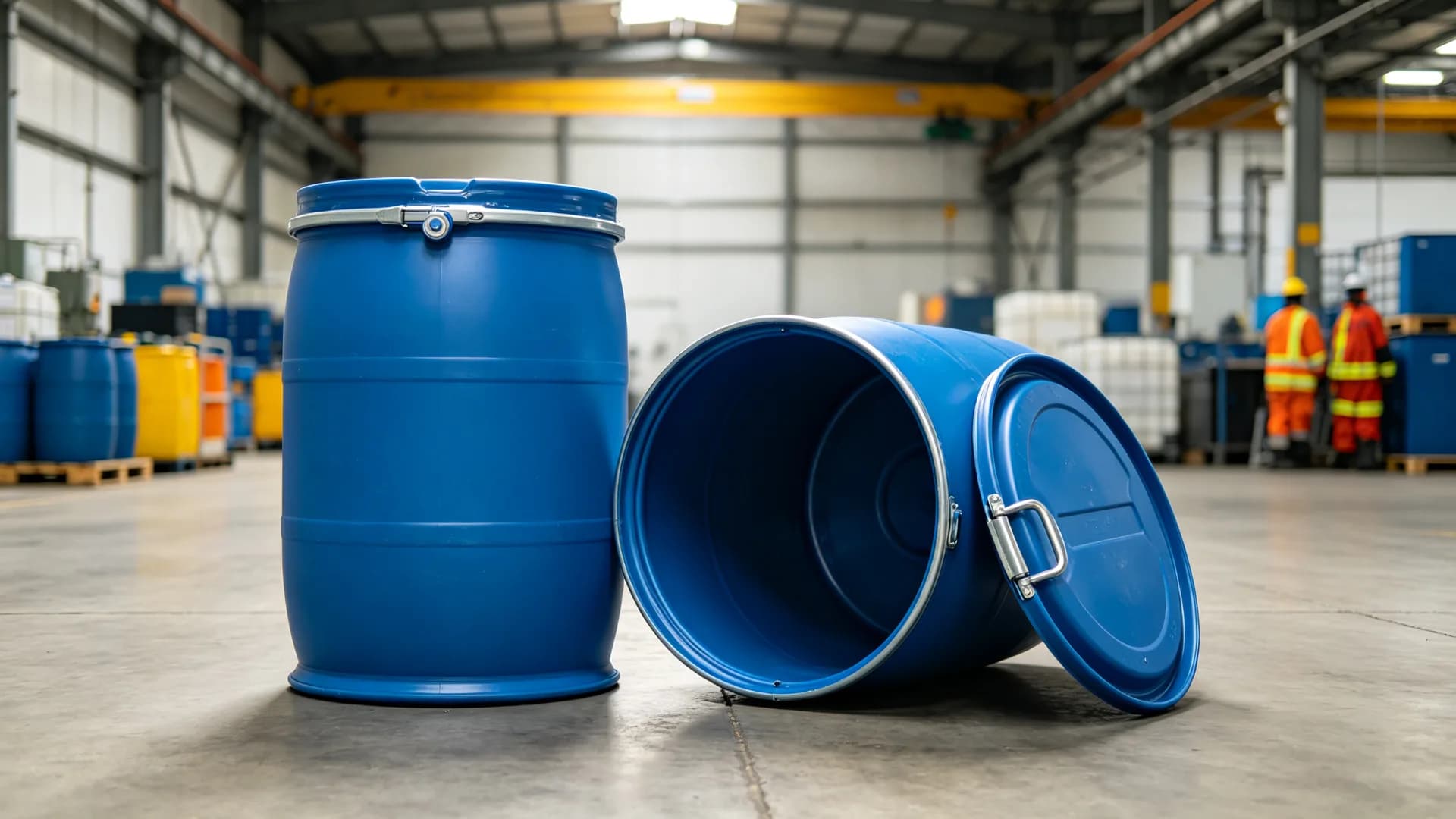
When needing to store 200 liters, almost everyone thinks of the familiar round plastic drum. But when ordering, you realize there are two types: closed lid and open lid. Many choose based on price or what is available in stock. After some use, they find it inconvenient.
Choosing the wrong lid type does not damage the drum. It just slows daily operations. Closed lid drums storing powder require scooping through a small opening each time. Open lid drums transporting liquids over long distances always require attention to the lid edge. Same capacity, same placement, but very different operation methods.
This article clearly explains the differences between the two lid types, the actual dimensions of each type according to product pages, and how to choose according to the product you are storing.
1. Two lid types for the same 200-liter capacity
The only difference lies in the lid, but it determines almost everything else.
Closed lid: lid is sealed to the body and cannot be removed. Filling and emptying go through screw-capped openings.
Open lid: removable lid, completely detachable from the body. The mouth has a metal locking band to secure the lid.
Besides the lid, both types are identical in the body: upright round plastic drums made of industrial plastic, delivered as 1 piece per pack. Both are listed in Minh Quân Plastic's industrial drum category.
2. 200L Closed Lid Drum: Fully sealed
200L plastic drum with closed lid measures Ø590 x height 918 mm, 200 liters capacity, blue color. The design is an upright round drum with a closed lid.
Because the lid cannot be removed, filling and emptying are done through screw-capped openings. This suits liquid materials or small loose solids that can pass through the filling opening. Cake-shaped powder, large granules, or block goods cannot pass through.
The closed lid type is further divided by the number of locking bands: 1 band, 2 bands, and 3 bands. When requesting a quote, specify the number of bands needed, as these are three different codes, not one.
The biggest advantage of the closed lid is no lid edge to worry about. Drums laid horizontally on trucks traveling rough roads keep contents inside. Just tightly screw the two openings.
3. Open Lid Drum: Easy access to contents
Open lid plastic drums come in 6 capacities, blue body, black lid, removable lid with metal locking band. The design is an upright round drum with a wide opening.
Dimensions by capacity:
30 liters: diameter 310 mm, height 540 mm
50 liters: diameter 380 mm, height 585 mm
100 liters: diameter 380 mm, height 760 mm
120 liters: diameter 430 mm, height 760 mm
160 liters: diameter 510 mm, height 980 mm
200 liters: diameter 580 mm, height 980 mm
Wide opening means the entire drum interior is visible when the lid is removed. You can scoop, ladle, reach inside, or line with a bag. After washing, you can clearly see if the bottom is clean.
In return, sealing depends on the locking band. If tightened evenly and sufficiently, the lid seals well. If loose on one side, the drum should only be stored upright.
4. Direct comparison of the two lid types
Sealing during transport
Closed lid is superior. Just tighten the screw caps, no edges to leak. Open lid seals when the locking band is properly tightened, but it is still a joint that must be checked after each opening.
Accessing contents
Open lid is much better. The entire drum mouth opens, allowing any amount to be taken quickly, even multiple times a day. Closed lid only empties through the openings, suitable for free-flowing goods.
Cleaning and reuse
Open lid is easier to clean because you can see inside and scrub the bottom. Closed lid can be cleaned but is hard to visually inspect, so usually dedicated to one product type.
Available capacities
Open lid drums come in 6 sizes from 30 liters to 200 liters. Closed lid is only available in 200 liters. If the warehouse needs multiple smaller sizes simultaneously, open lid is more flexible.
Warehouse space
The two 200-liter types differ in size. Closed lid Ø590 x height 918 mm, open lid Ø580 x height 980 mm. Closed lid is 10 mm wider but 62 mm shorter. The 62 mm difference is important if stacking drums on racks or transporting in covered vehicles.
5. Choosing based on needs: common scenarios
Liquid goods, long-distance transport, multiple handling
Choose closed lid. This is what it does best. Load once, open only at the destination.
Loose goods, powders, frequent daily access
Choose open lid. If you open several times a day, the wide mouth saves a lot of time compared to scooping through an opening.
Soaking, fermenting, mixing inside the drum
Choose open lid. You need to insert a stirrer or mixing rod, see the product level inside, and add ingredients during the process.
Need sealing and access control
Choose closed lid. The screw-capped openings have fewer sealing points and are clearer.
One drum used for multiple seasonal products
Choose open lid. Frequent washing between uses is required, and this type cleans faster.
Tight warehouse, low racks, covered vehicles
Measure first. Take the height inside racks or vehicle cargo area, subtract clearance for handling, then compare with 918 mm and 980 mm.
6. When 200 liters is not the right number
Many buyers default to 200 liters, while actual needs may differ.
If small quantities are taken out continuously and manual handling is needed, the open lid sizes 30, 50, 100, or 120 liters are more suitable. No one carries a full 200-liter drum; a pallet or vehicle is needed.
If much larger quantities are needed, consider the 1000L steel frame IBC plastic tank. Dimensions 1200 x 1000 x 1155 mm, 1000 liters capacity, translucent white tank with metal frame outside. One tank replaces five 200-liter drums, and the steel frame allows direct forklift handling.
If only stationary storage is needed without sealed lids for transport, round plastic containers with open mouth come in 200L, 250L, 350L, 400L, 750L, 1000L, and 1500L. For tight wall placement or neat row stacking, rectangular plastic containers are available in 50L, 100L, 200L, 500L, 750L, and 1000L, block-shaped to avoid open corners like round containers.
7. Stacking and moving drums in the warehouse
This part is often overlooked but is the main cause of drum damage. No one drags a full 200-liter drum by hand on concrete. A few drags wear the bottom thin.
The neatest way is to place drums on pallets upon receipt, then move the whole set with a pallet jack.
Plastic pallet with solid top, no feet: size 1000 x 600 x 35 mm, static load 11,020 lbs (5,000 kg). Solid top ensures even drum bottom contact, 35 mm thick so minimal height added. Used for stationary upright drum stacking.
Plastic pallet with 3 feet: size 1200 x 800 x 150 mm, static load 6,610 lbs (3,000 kg), dynamic load 2,200 lbs (1,000 kg). Feet allow pallet jack forks to enter, used for drum sets needing frequent movement.
Plastic spill containment pallet: size 1300 x 1300 x 300 mm, weight 66.1 lbs (30 kg) ±5%, static load 9,920 lbs (4,500 kg), dynamic load 3,300 lbs (1,500 kg). Removable grid top with containment sump below. Used for liquid drum storage areas; leaks stay contained instead of spilling on floor.
Note dynamic load is always less than static load. Static is when pallet is stationary; dynamic is when moved by forklift. Stack drums according to dynamic load, not static.
8. Tips for long-lasting plastic drums
Plastic drums rarely fail due to contents. Mostly due to handling, storage, and screwing methods.
Do not drag or roll on rough concrete. Where frequent movement is needed, use pallets or drum dollies.
For open lids, tighten locking bands evenly around the circumference, not just one side fully. Uneven tightening leaves one side of the lid edge open, invisible to the eye.
For closed lids, screw caps by hand or with properly sized tools. Using pliers to overtighten causes thread neck cracks quickly, ruining the seal.
Do not leave drums in direct sunlight all day. Continuous sun exposure makes plastic brittle over time. Even a simple metal roof extends lifespan significantly.
Do not store hot contents. Let cool before filling. Hot filling deforms the drum body, causing stacking instability.
Clean immediately after emptying. Dried residue inside makes subsequent cleaning much harder and more water-consuming.
Do not stack drums too high. The bottom drum bears the entire load, and plastic drum bodies are not load-bearing structures.
Label according to product type and keep the label. A drum used for chemicals should not be reused for raw materials. Labeling from day one prevents mix-ups.
Following these tips allows plastic drums to be used for many cycles, and replacement is due to changing needs, not damage.
In summary, the choice is clear: closed lid for liquids transported long distances, open lid for frequent access. If unsure, calculate how many times per week you open the drum. Frequent opening means open lid is almost always correct. Also measure storage height before ordering, as 918 mm and 980 mm make a big difference in tight warehouses.
Minh Quân Plastic supplies closed lid and open lid plastic drums, IBC plastic tanks, plastic pallets, and industrial plastic containers, with warehouse in Ho Chi Minh City and nationwide delivery. If you provide the product type, weekly access frequency, and drum placement, we will advise the correct lid type and size with quantity-based quotes. Call 0907 722 345 for pricing and stock availability.