
Plastic Pallets for Cold Storage: Key Points to Note
📅 Sep 25, 2026
👁 0 views
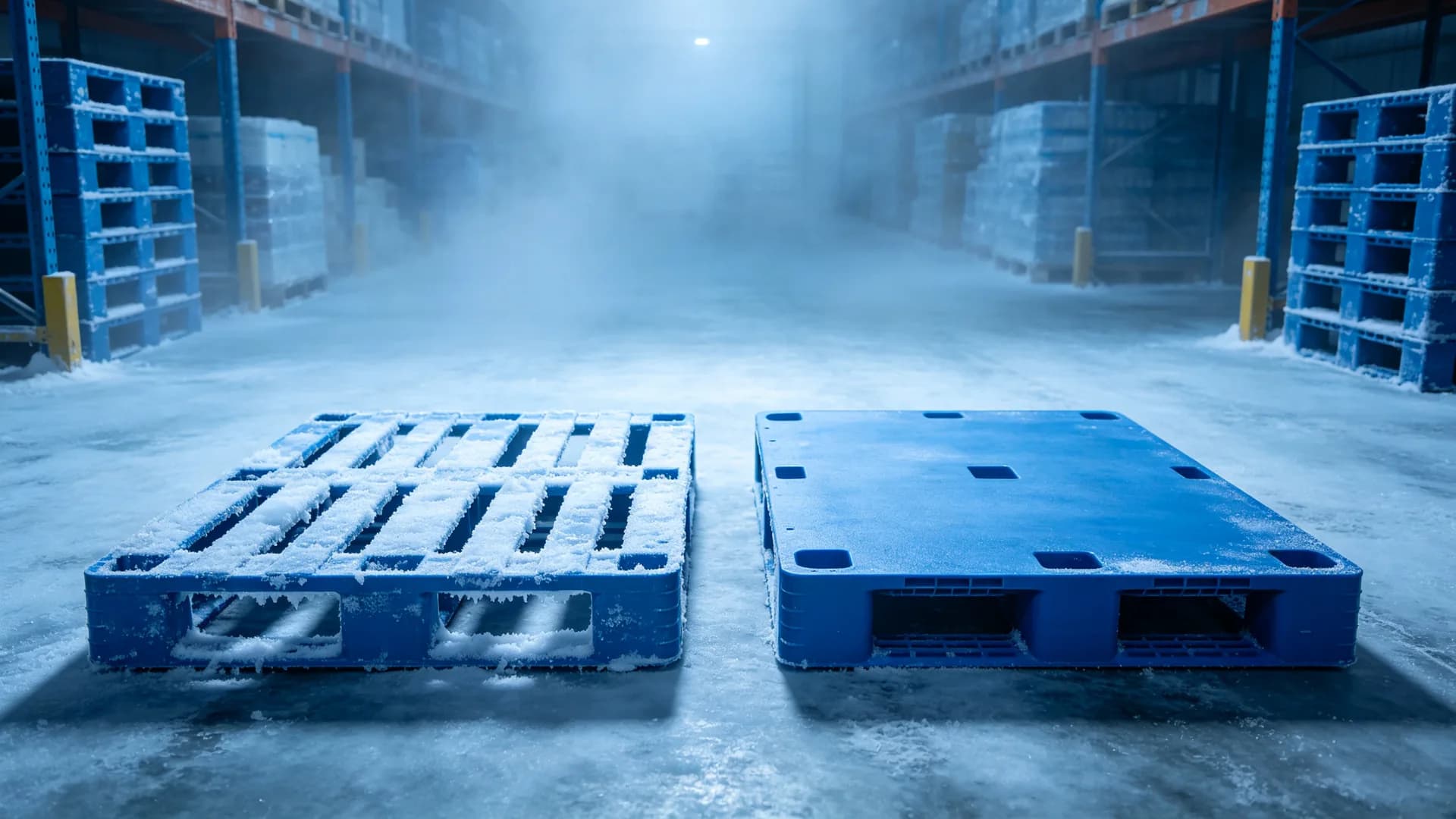
Cold storage is where pallets have the toughest working conditions. Goods are stacked high, forklifts run continuously, floors are damp with standing water, and pallets are regularly washed and sprayed with cleaning solutions. A pallet that works well in a regular warehouse can start cracking at the legs, sagging on the surface, or slipping under forklift forks after just a few months in cold storage.
The most common issue is buying pallets based on price rather than working conditions. Buyers see two pallets of the same size and load rating of 6,610 lbs (3,000 kg), with a price difference of a few tens of thousands VND, and choose the cheaper one. In cold storage, the cheaper pallet is more brittle, legs break first, and the cost of replacing pallets mid-season exceeds the initial savings.
This article covers the key factors that determine whether a plastic pallet can survive in cold storage: type of plastic, surface style, leg style, how to read load ratings, and usage tips for durability. The specifications cited are from Minh Quân Plastic's product pages.
1. Challenges Cold Storage Poses to Pallets
Four factors simultaneously affect pallets in cold storage, each damaging pallets in different ways.
Low temperature. Plastic becomes harder and more brittle as temperature drops. Impacts that pallets withstand in regular warehouses can crack pallet legs in freezing conditions.
Water and humidity. Cold storage floors almost always have standing water or thin ice. Wooden pallets absorb water, become heavier, moldy, and rot. Plastic pallets do not absorb water, which is why plastic is preferred.
Washing and sanitation. Food warehouses must regularly wash pallets. Pallets with many closed cavities trap water and are harder to clean.
Forklifts and high stacking. Cold storage space is expensive per cubic meter, so goods are stacked high. Pallets on lower tiers bear the full weight of the goods above.
Each choice in the following sections addresses one of these four factors.
2. Virgin Plastic or Recycled Plastic: Choose According to Storage Temperature
This is the most important and often overlooked factor when comparing prices. Virgin plastic has better toughness and retains it at low temperatures. Recycled plastic is cheaper but its molecular chains have been heat-processed multiple times, making it more brittle and prone to cracking at low temperatures.
Practical rule: the colder the storage, the more you should favor virgin plastic. For cool storage, light goods, and infrequent forklift use, recycled plastic is still usable and saves significant cost.
Most pallets on the website offer plastic options. For example, the 3-leg plastic pallet with mesh surface 1000 x 1200 x 150 mm comes in three types: virgin green plastic, recycled green plastic, and recycled black plastic. Same mold and size, differing only in plastic type. When ordering for cold storage, specify the plastic type rather than just the pallet name.
The 3-leg plastic pallet 1200 x 800 x 150 mm uses virgin or recycled HDPE plastic, weighs 29.8–30.9 lbs (13.5–14 kg) with a 5% tolerance. The product page clearly states this pallet is suitable for factories, warehouses, cold storage, and distribution centers.
3. Mesh Surface or Solid Surface: Comparison for Cold Storage Conditions
Two pallet surface styles serve different needs. Neither is absolutely better; suitability depends on the type of goods.
Mesh Surface
Water drains quickly, does not pool on the pallet surface. Dries immediately after washing.
Cold air passes through the load better, cooling goods inside the pallet.
Lighter for the same size, easier for workers to handle.
Not suitable for loose goods or soft bags as goods sink into the mesh cells.
This group includes the cross-style plastic pallet 1200 x 1000 x 150 mm, mesh surface with stiffening ribs, weighing 26.5 lbs (12 kg) with 5% tolerance, static load rating 3,960 lbs (1,800 kg) and dynamic load rating 1,760 lbs (800 kg). Lightweight yet supports medium loads.
Solid Surface
Loose goods, powder bags, and small cartons do not sink or fall through.
Flat surface stabilizes stacked goods, reducing layer shifting.
Easy to quickly wipe between loads.
Requires attention to draining water after washing, as solid surfaces do not self-drain like mesh.
Example is the cup-leg plastic pallet with solid surface 1000 x 1200 x 140 mm, made of PP plastic with three options: virgin, recycled green, or recycled black, weighing 19.8 lbs (9 kg) with 5% tolerance. The product page states load ratings vary by plastic type and stacking method, so when requesting a quote, specify the weight and number of stacking layers for accurate technical advice.
In summary: boxed goods needing quick cooling use mesh surface. Bagged, loose, or small carton goods use solid surface.
4. Leg Style and Forklift Entry Direction
Leg style determines how many directions forklifts can enter. In cold storage, aisles are usually narrower than in regular warehouses because every square meter costs to cool, so forklift entry direction directly affects loading/unloading time.
3-leg pallets allow forklift entry from two opposite ends. The product page for 3-leg plastic pallets clearly states the three-leg structure allows lifting from two sides, compatible with manual and powered forklifts. This style is compact, lightweight, and suitable when goods flow in a fixed direction.
Cup-leg pallets allow forklift entry from four directions. You don’t need to rotate the pallet before lifting, speeding up operations in narrow aisles. Besides the solid surface type mentioned above, there is also a 9-cup-leg plastic pallet 1200 x 800 x 140 mm made of PP plastic, with three plastic options and load ratings depending on plastic type and stacking method.
5. Correctly Reading Static and Dynamic Load Ratings
These two numbers differ greatly, and confusing them is a common cause of early pallet failure.
Static load rating is the weight a pallet can bear when resting stationary on a flat floor.
Dynamic load rating is the weight a pallet can bear while being moved by a forklift.
Looking at the 3-leg plastic pallet, the difference is clear: static load 6,610 lbs (3,000 kg) but dynamic load only 2,200 lbs (1,000 kg). The cross-style plastic pallet is similar, static 3,960 lbs (1,800 kg) and dynamic 1,760 lbs (800 kg). When calculating loads for a pallet in motion, use the dynamic load rating.
In cold storage, allow a safety margin below the product page rating. This is because plastic is more brittle in the cold, and each time a forklift sets down a pallet, it causes a small impact. Calculating loads below the limit extends pallet lifespan.
Some pallets on the website list load ratings as ranges. The plastic pallet with legs and perforated surface 1000 x 600 x 100 mm made of HDPE or PP lists static load from 2,200–4,400 lbs (1,000–2,000 kg). This range depends on plastic type, so confirm with technical staff which rating applies when finalizing orders.
6. Floor Liner Pallets for Cold Storage: Often Overlooked
Not all areas in cold storage require pallets with legs. Many areas only need to raise goods slightly off the floor to prevent water contact with packaging, and legless floor liner pallets do this better, taking up less height and costing less.
The legless plastic floor liner pallet with solid surface 1000 x 600 x 35 mm is the most notable in this group. Made of virgin or recycled HDPE plastic, blue color, weighing only 9.9 lbs (4.5 kg) with 1.1 lbs (0.5 kg) tolerance, yet static load up to 11,020 lbs (5,000 kg). The product page states it is suitable for food, pharmaceutical, cold storage, or humid environments and is easy to clean with water or cleaning solutions.
The perforated surface version is the legless plastic floor liner pallet with perforated surface 1000 x 600 x 35 mm, black color, virgin or recycled plastic, static load approximately 4,400–8,810 lbs (2,000–4,000 kg). Choose this version when water drainage is needed; choose solid surface when goods must not fall through the pallet surface.
An effective approach is to use floor liner pallets for fixed storage areas and legged pallets for goods moved by forklifts.
7. How to Choose Plastic Pallets for Cold Storage by Case
Freezing storage, heavy goods, frequent forklift use
Prioritize virgin plastic. Choose pallets with clearly stated static and dynamic load ratings for accurate load calculation, e.g., 3-leg plastic pallets or 3-leg mesh surface pallets with static load 6,610 lbs (3,000 kg) and dynamic load 2,200 lbs (1,000 kg). Calculate loads based on dynamic rating and allow safety margin.
Cool storage, carton goods, multiple stacking layers
Solid surface prevents small cartons from falling through. The cup-leg solid surface plastic pallet 1000 x 1200 x 140 mm weighs 19.8 lbs (9 kg), easy for workers to handle, and allows forklift entry from four directions. Remember to confirm load ratings with technical staff based on plastic type and stacking method.
Seafood, meat, goods requiring frequent washing
Choose mesh surface for quick water drainage after each wash, combined with virgin plastic if storage temperature is low. Mesh surface also allows cold air to penetrate the load.
Fixed storage areas, no forklift entry needed
Legless floor liner pallets are the most economical choice. Solid surface version supports static load up to 11,020 lbs (5,000 kg) for heavy stacked goods; perforated surface version is for drainage needs.
New warehouse, undecided on goods type
Choose common sizes first, e.g., 1200 x 1000 mm or 1000 x 1200 mm, so racks and forklifts can still be used if goods type changes later. See the full industrial plastic pallet catalog to compare sizes and leg styles.
8. Tips for Using Plastic Pallets Durably in Cold Storage
Choosing the right pallet is only half the solution. The other half is daily usage.
Do not subject cold pallets to strong impacts. Remind forklift drivers to lower pallets gently and avoid dropping from height. This simple step saves many pallets.
Place pallets in the warehouse before loading goods. Let pallets cool gradually inside rather than loading heavy goods immediately after bringing them in from hot outdoors.
Lift in the correct leg direction. 3-leg pallets accept forks only from two ends. Trying to lift from the other sides breaks legs.
Drain pallets after washing. Water trapped in solid surface pallets freezes in freezing storage, expands, and creates internal pressure in the plastic.
Distribute loads evenly on the pallet surface. Concentrating weight in one corner causes local sagging even if total weight is within limits.
Remove pallets with cracked legs from use. Damaged pallets mixed with good ones cause stacking collapses.
Label pallets by plastic type. If both virgin and recycled plastics are used, mark pallets so virgin plastic ones are always used in the coldest areas.
9. Points to Confirm Before Ordering
Before finalizing quantities, clearly communicate the following four details to the seller.
Operating temperature of the warehouse: cool or freezing.
Weight of one load unit and number of stacking layers per pallet.
Type of forklift used and forklift entry direction in aisles.
Type of goods: bagged, loose, or carton-packed.
For pallets with load ratings given as ranges or by plastic type, these four details enable technical staff to confirm the exact rating for your case.
Minh Quân Plastic supplies industrial plastic pallets with various leg styles, surface types, and options for virgin or recycled plastic, suitable for cold storage, food warehouses, and factories. Nationwide delivery from Ho Chi Minh City.
For consultation on choosing pallets for cold storage or quantity-based quotes, call 0907 722 345 to specify warehouse temperature, load weight, and forklift type. Technical staff will recommend suitable pallet and plastic types with pricing based on actual quantities.