
Plastic Crates for Seafood: Which Type to Choose for Shrimp, Fish, and Squid
📅 Sep 16, 2026
👁 0 views
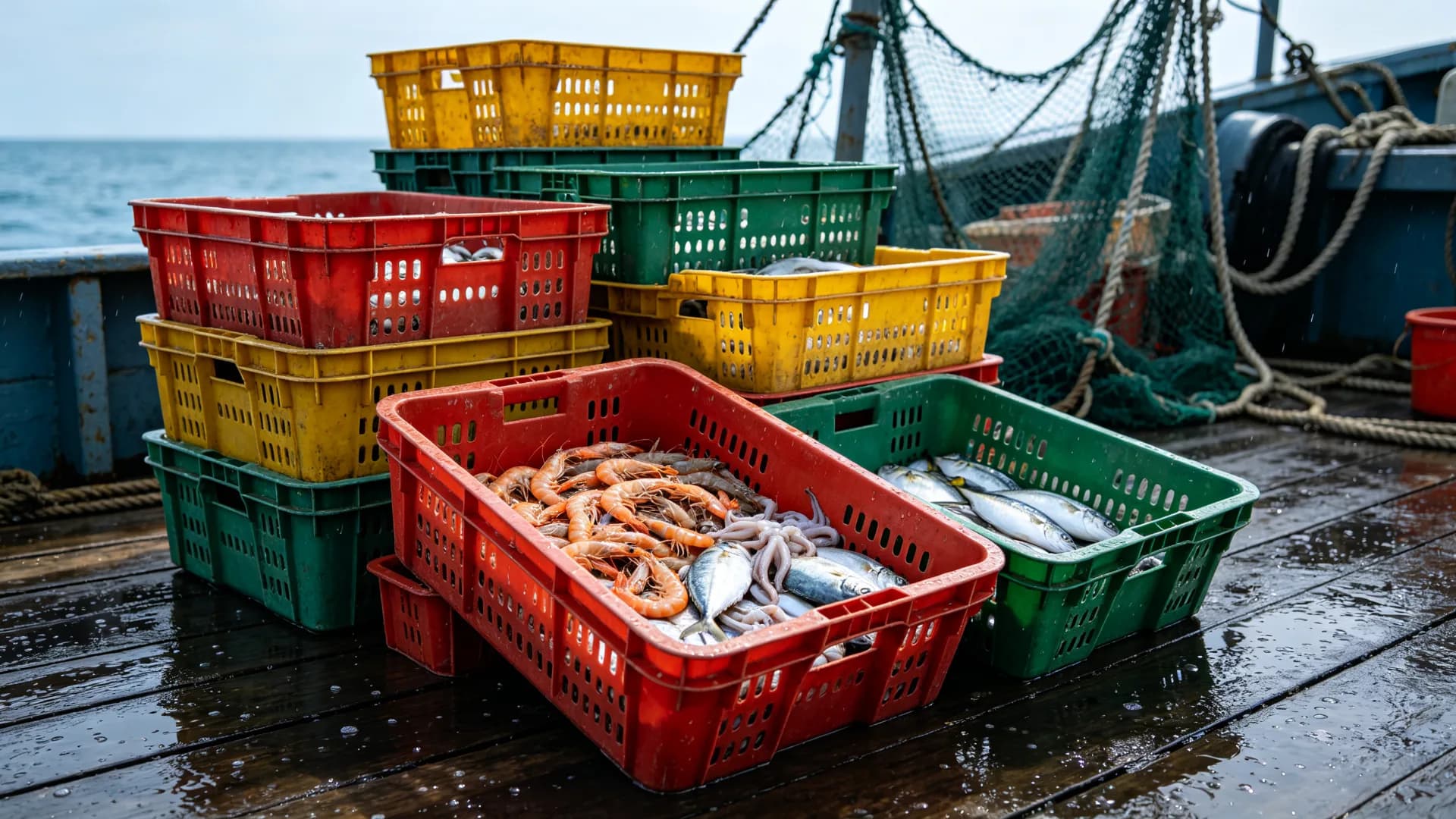
At seafood hubs and processing workshops, the most common issue is not a shortage of plastic crates, but using the wrong type. Shrimp just sorted into crates that are too deep get crushed at the bottom by the upper layers by packing time. Fish placed in short crates must be bent. Squid stored in tall crates retain water at the bottom because it cannot drain quickly enough.
These problems do not stem from plastic quality but from crate internal dimensions and wall design. Each seafood product has a unique shape and softness, requiring a specific crate interior. Choosing correctly from the start reduces product damage, speeds up handling, and extends crate lifespan.
This article covers three specialized crates for shrimp, fish, and squid: actual dimensions of each, usage stages, when to switch to large open crates or containers, and how to maintain crate durability in saltwater environments.
1. How seafood crates differ from regular plastic crates
The first difference is design. All three types for shrimp, fish, and squid have open walls and ventilated bottoms. Melted ice water drains immediately, preventing goods from soaking in dirty water during the shift.
The second difference is crate internal height. Open plastic crates used indoors can be as tall as 39 cm. Filling seafood into such deep interiors means the bottom layer bears the weight of all layers above. Seafood-specific crates go the opposite way: shallow interiors holding only one to two layers to avoid crushing.
The third difference is material. Fish crates and shrimp crates are made of PP plastic. Squid crates are made of PP and HDPE plastics. All three resist water, salt, and frequent daily washing.
2. Shrimp crates: compact interior, single-person lift
Shrimp crates measure 46.5 x 33.3 x 15.5 cm, made of PP plastic, with open walls and ventilated bottom. This type has the shortest length among the three but is the widest and tallest.
This shape suits shrimp because they do not need to lie straight. What matters is enough width to spread evenly during sorting and enough height to cover a layer of ice without overflow. The short interior also allows one person to carry a full crate with shrimp and ice, avoiding two-person lifts.
In workshops, this type typically follows the entire line: receiving at ponds or docks, transferring to sorting tables, then stacking for packing. Crates are packed 50 per bundle, available in four colors: blue, red, green, and yellow.
3. Fish crates: longer to accommodate straight fish
Fish crates measure 51.9 x 31.9 x 14.6 cm, made of PP plastic, with open walls and ventilated bottom. Compared to shrimp crates, this type is 5 cm longer and nearly 1.5 cm narrower.
Though the difference seems small, it is critical. Fish need space to lie stretched lengthwise. If the crate interior is shorter than the fish body, workers must stack diagonally or bend the fish, both of which deform the fish and reduce sale value.
The 14.6 cm height is designed for hand operations. Workers at the table can see the entire contents, remove and place fish without reaching deep. The crate walls have reinforcing ribs, handles on both sides, and crates stack securely. Packing is 25 per bundle, with the same four colors as above.
4. Squid crates: shallowest of the three
Squid crates measure 50.6 x 30.6 x 10.2 cm, made of PP and HDPE plastics, with open walls and ventilated bottom. The height is only 10.2 cm, over 5 cm shallower than shrimp crates.
This is due to squid characteristics. Squid are soft, easily crushed, and release much liquid. Stacking multiple layers in a deep crate compresses the bottom layer and deforms the squid. The shallow interior forces thin stacking, preserving each squid's shape.
Multiple ventilation slots on walls and bottom allow continuous drainage. The compact size fits easily on processing tables or conveyors without occupying much space. This type is packed 25 per bundle.
5. Quick comparison of the three crate types
The three types look similar and are easily confused. Below is how to distinguish by each dimension.
By internal length
Fish crate longest: 51.9 cm
Squid crate: 50.6 cm
Shrimp crate shortest: 46.5 cm
By width
Shrimp crate widest: 33.3 cm
Fish crate: 31.9 cm
Squid crate narrowest: 30.6 cm
By height
Shrimp crate tallest: 15.5 cm
Fish crate: 14.6 cm
Squid crate shallowest: 10.2 cm
By material and packing
Shrimp crate: PP plastic, 50 per bundle
Fish crate: PP plastic, 25 per bundle
Squid crate: PP and HDPE plastics, 25 per bundle
Simple memory aid: need length, choose fish crate; need shallow, choose squid crate; need width and one-hand carry, choose shrimp crate. All three come in four colors: blue, red, green, yellow.
6. When to use large crates, closed crates, or containers
The three types above cover direct contact with goods. However, seafood workshops have other tasks requiring different containers.
Collecting and moving goods inside the workshop. Carrying small crates over long distances is laborious. Use wheeled types then. Open plastic crate 5T4 with 8 wheels measures 84 x 62.2 x 53.4 cm, tolerance ±0.5 cm, made of HDPE plastic, ventilated mesh walls, can be pushed without lifting. For narrower aisles, a smaller version 4T5 with 5 wheels measures 77.8 x 49.6 x 44.5 cm.
Preventing water leakage onto floors. When transferring goods through dry areas or loading onto vehicles, open crates drip water along the way. Use closed plastic crate 2T5, size 61 x 42 x 25 cm, with sealed walls and bottom, made of HDPE.
Soaking, chilling, or holding water. This requires large capacity. Rectangular plastic bins come in 50L, 100L, 200L, 500L, 750L, and 1000L sizes, open top, sealed bottom. The 200L bin has a mouth length of 91 cm, height 41 cm, bottom length 76 cm. The 500L bin has mouth length 132 cm, height 66 cm, bottom length 95 cm.
7. Selection by processing stage
Instead of choosing by product name, a faster method is to follow the product flow in the workshop.
Receiving at dock or pond
Prioritize crates that can be carried by hand and drain quickly: shrimp or fish crates depending on product. Quantity should be calculated with surplus as this stage often accumulates goods simultaneously.
Sorting at table
A shallow interior is needed for clear visibility and easy reach to the bottom. The 10.2 cm high squid crate is best suited, even if the product is not squid.
Transferring between areas
For short distances, stack crates and carry. For long distances or heavy goods, switch to wheeled types. See other options in the open plastic crate category to select height suitable for aisle width and table height.
Waiting for freezing or packing
This is when goods remain stationary longest, so crates should be elevated off the floor and stacked neatly. Shallow interiors remain better than deep ones, as goods left long under pressure deform.
8. Tips to maintain crate durability in saltwater environments
PP and HDPE plastics resist water well, but daily usage determines crate lifespan.
Wash immediately after shift; do not leave overnight. Fish oils and salt residues clog ventilation slots, making cleaning difficult and blocking drainage, thus losing crate functionality.
Do not throw crates when goods just out of cold storage. Cold plastic is more brittle; strong impacts can crack corners and chip ribs.
Stack crates properly. Crates bear load best when top four corners align with bottom four corners. Misaligned stacking concentrates weight on crate walls, causing them to bend outward over time and preventing tight stacking.
Do not place crates directly on wet floors. Bottoms contacting dirty water then stacking on other crates create the shortest cross-contamination path. Elevating on pallets is the simplest way to break this chain.
Use color coding by product or processing stage. Four available colors suffice to separate raw from processed goods or shrimp from fish. New workers can identify by color without asking.
For stacking, plastic pallets with cup feet sized 1200 x 1200 mm, mesh surface, made of virgin plastic, have static load capacity around 6,000 kg and dynamic load capacity around 2,000 kg, suitable for areas stacking many crates with forklift access. For floor lining only, thinner pallets 35 mm thick suffice to separate goods from damp floors.
9. Ordering: by bundle and color
Seafood crates are sold by bundles, not individually, so quantity calculations must consider packing specifications. Shrimp crates pack 50 per bundle. Fish and squid crates pack 25 per bundle. Workshops running two shifts usually need more crates than one shift's output, as some are always waiting to be washed.
Regarding colors, finalize color coding before ordering instead of buying small amounts of each. For example, the entire workshop agrees on blue for newly received goods, yellow for sorted goods, red for rejected goods. Later additions should follow the same ratio.
Minh Quân Plastic in Ho Chi Minh City delivers nationwide, so seafood hubs in the Mekong Delta and Central regions can order by bundle.
The three key numbers to remember are heights: shrimp crate 15.5 cm, fish crate 14.6 cm, squid crate 10.2 cm. Height determines whether goods get crushed and directly affects loss rate. Length determines if fish can lie straight. These two parameters should be checked before considering color or quantity.
If you are considering several types or want to calculate crate quantity per shift output, call 0907 722 345 for consultation and bundle pricing. Provide product type, daily output, and delivery area for faster quotes, including pallet options if needed.