
How Many Liters of Plastic Waste Bin Is Enough? Calculation Based on Daily Waste Volume
📅 Sep 4, 2026
👁 1 views
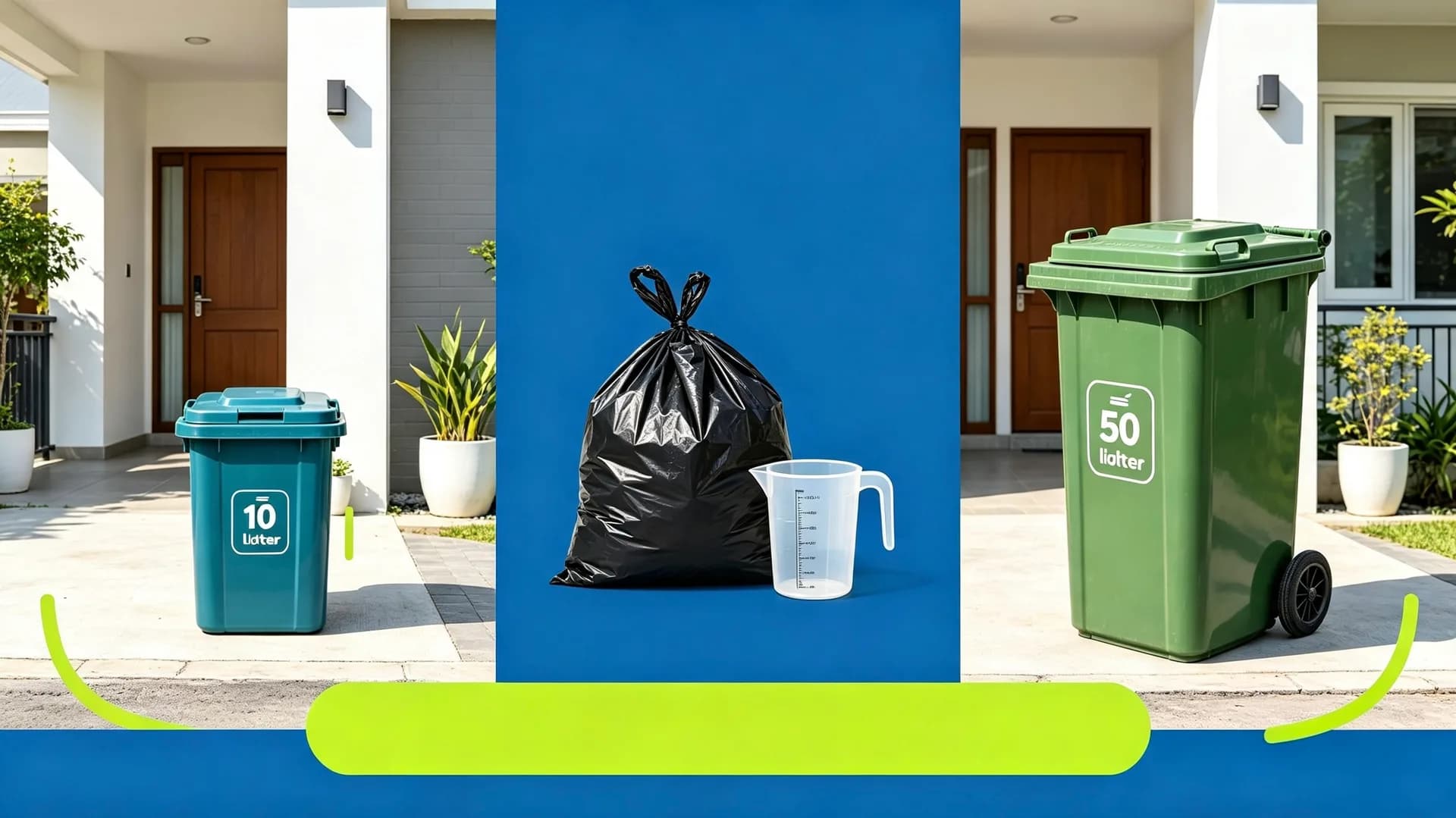
Many factories purchase waste bins based on guesswork. They buy large bins if they look big, or buy a batch of the same size for the entire workshop if the price is good. A few weeks later, problems emerge: bins in the packaging area overflow by mid-shift, while bins in the office corridor are still less than half full by the end of the week.
Choosing the wrong capacity does not cause immediate damage. It gradually increases costs. The cleaning team has to make more collection rounds. Waste piles up over the bin rim and falls onto the floor. Odors rise in the production area because waste stays too long in oversized bins. Eventually, additional bins must be purchased to compensate.
This article reverses the usual buying habit: first measure the factory's actual waste volume, then finalize the bin capacity. Measuring takes about a week but doing it once benefits the entire factory.
1. Where Does Choosing the Wrong Capacity Waste Money?
Bins smaller than needed are the most obvious mistake. Waste fills to the rim by mid-shift, workers compress it to fit, bags tear, and liquid waste leaks onto the floor. The cleaning team must make an extra collection round. One extra round per shift, multiplied by the number of days in a year, is a significant labor cost that no one records.
Bins larger than needed cause quieter but still troublesome issues. Waste fills only after several days, especially food waste, and odors appear first. Large bins also occupy floor space, obstruct forklift paths, and become very heavy when full. For example, a 660-liter plastic waste bin shell weighs 43 kg, and a 1100-liter one weighs 52 kg. Adding the waste inside, one person can hardly push it if the floor is uneven.
Another less noticed mistake is choosing the correct capacity but the wrong bin type. For example, for 120 liters, the processing area needs foot pedal bins, office corridors suit swing lid bins, and the collection area requires bins with wheels.
2. Measure the Factory's Actual Waste Volume Over One Week
No need to weigh or use complicated forms. Just place a sheet of paper in each area and ask the cleaning team to record three things each time they collect waste.
Collection time.
Number of bags taken out and their size.
Bin fill level at that time: less than half, about half, near the rim, or overflowing.
Record continuously for seven days, including peak days. Factory waste volume varies: on raw material delivery days, bins fill with packaging and shrink wrap; on machine-only operation days, waste is much less. Use peak day data as the standard, not average days, because even one wrong day means waste ends up on the floor.
To know how many liters one waste bag occupies, take the exact bag type used, fill it with actual waste to the usual level or tied shut, then place it in a bin with known capacity and see what fraction it occupies. This rough method yields numbers specific to your factory, not borrowed figures.
3. From Measured Data to Bin Capacity
The principle is simple: the bin capacity must hold the waste generated between two collections, with extra space remaining.
If collecting once per shift, the bin must hold all waste from one shift. If collecting once per day, it must hold all waste from one day. The extra space cushions peak days and bulky, non-compressible items like cartons or foam trays.
If the measurement falls between two bin sizes, there are two approaches.
Choose the larger size if the area cannot increase collection frequency or if bulky waste is common.
Choose the smaller size but place two bins if waste needs sorting or if narrow aisles cannot accommodate large bins.
The second approach has an added benefit: two smaller bins placed at two points shorten the distance workers walk to dispose of waste. People only tolerate a few steps; beyond that, waste starts accumulating in machine corners.
4. Comparison of Common Capacity Sizes
Below are common capacity sizes and suitable usage areas for each.
8 to 30 liters
Size for indoor rooms. A 20-liter medical waste bin made of premium PP plastic measures 350 x 330 x 450 mm, fitting narrow corridor corners. A 30-liter plastic waste bin measures 350 x 380 x 520 mm, one-piece body with lid, suitable for offices and restrooms. This size is ideal for daily collection.
40 to 70 liters
The most commonly used size in areas with foot traffic. The 60-liter plastic waste bin measures 420 x 470 x 660 mm, available in eight colors for sorting, and can be fitted with wheels for mobility. The 40-liter foot pedal bin with 2 compartments splits into two 20-liter sections, measuring 430 x 340 x 480 mm, suitable for kitchens and areas requiring immediate waste separation.
90 to 120 liters
Transition size between fixed bins and mobile bins. The 100-liter plastic waste bin measures 470 x 350 x 765 mm. The 120-liter plastic waste bin with 2 wheels keeps the same 470 x 350 mm base but is 890 mm high and weighs 8 kg. This means you can add 20 liters without increasing floor space by choosing a taller model. For kitchens, there is the 120-liter foot pedal bin made of UV-stabilized HDPE plastic, measuring 540 x 450 x 920 mm.
240 liters
This is the most frequently requested size for factories. The 240-liter plastic waste bin with 2 wheels measures 730 x 585 x 1030 mm, shell weighs 11 kg, available in seven colors. Two wheels allow tilting and pulling instead of lifting. This size suits production workshops, packaging areas, apartment complexes, and schools.
360 to 660 liters
The 360-liter plastic waste bin measures 830 x 700 x 1100 mm, shell weighs 21 kg. The 660-liter plastic waste bin with 4 wheels measures 1350 x 830 x 1110 mm, shell weighs 43 kg, rectangular shape, available in four colors. From this size up, bins serve as collection points rather than indoor workshop bins.
1100 liters
The 1100-liter plastic waste bin with 4 wheels measures 1360 x 1060 x 1370 mm, shell weighs 52 kg, with four 20 cm diameter wheels. This size is placed at final collection points where garbage trucks pick up waste. Before ordering, check two things: whether the placement area has at least 1.36 meters width, and whether the floor from the placement spot to the truck access road is flat.
5. Actual Dimensions Are as Important as Capacity
Many orders must be changed because bins do not fit through doors. Capacity is a number on paper; what determines whether a bin fits is the three dimensions: length, width, height. Before finalizing an order, measure these four places and compare with bin dimensions.
Door width and aisle width the bin must pass through when pulled to collection points.
Ceiling height at placement spot, especially under stairs or inside wall recesses.
Width of the intended placement space plus the lid opening space behind.
Freight elevator interior dimensions if the bin must move between floors.
A space-saving tip: when two bin sizes share the same base dimensions, choosing the larger size does not require more floor space because the extra volume is in height. For example, 100-liter and 120-liter two-wheel bins share a 470 x 350 mm base, differing only in height: 765 mm versus 890 mm.
6. Choose Capacity by Factory Area
No single bin size suits the entire factory. Dividing by area and choosing separately is more adequate and cost-effective.
Office and Corridors
Waste is mainly paper, plastic cups, and small packaging. Volume is low but bins must be compact and covered. Sizes from 30 to 60 liters are suitable. In high-traffic areas, swing lid bins are more convenient: a light push disposes waste and the lid closes automatically.
Kitchen and Processing Area
Waste is heavy, wet, and odors develop quickly; operators often have both hands busy. Foot pedal bins are recommended to open lids hands-free. Two-compartment bins help separate waste at the source without taking extra space.
Production Workshop and Packaging Area
Waste is bulky: cartons, shrink wrap, straps, scrap. This waste occupies more volume than weight, so these areas need larger bins than initially expected. Sizes from 120 to 240 liters with wheels are appropriate.
Collection Area Waiting for Garbage Truck
Choose based on garbage truck pickup frequency. Daily pickups usually require 360 to 660 liters. If pickups occur every other day, choose 1100 liters or multiple bins.
Factory Medical Room
Use dedicated medical waste bins, not shared with general waste. Sizes from 8 to 20 liters suffice, and bins should be distinctly colored to avoid mix-ups.
7. Tips for Long-Lasting Plastic Waste Bins
Plastic bins rarely fail due to material lifespan. Most damage results from misuse.
Do not compress waste above the bin rim. Compressing prevents the lid from closing, stresses the lid hinge in the wrong direction, causing it to break first. Collect waste when it reaches the rim; do not wait to compress more.
Do not drag large bins on rough floors. For wheeled bins, tilt and push in the wheel direction. Dragging wears the base and bends wheel axles.
Clean bins regularly. HDPE bodies are seamless and smooth; rinsing with water is sufficient. Waste residue that hardens must be scraped off, which scratches the surface and causes faster future buildup.
Protect from sunlight if placed outdoors. Prolonged sun exposure makes plastic brittle and discolored. Some models include UV stabilizers for better sun resistance, but placing bins under shelter is still more durable.
Do not use waste bins to store chemicals. Chemicals require dedicated bin types. Misuse causes bin damage, but leaks pose a bigger hazard.
Check wheels monthly. Stuck wheels are the main reason workers drag bins instead of rolling them.
Bin color should be planned from the start. Using colors to sort waste is cheaper and easier to remember than labeling. If your factory has a color code, inform us before ordering, as some colors are only available on request, not in stock.
8. Summary of Capacity Selection Process
Divide the factory into areas generating different waste types.
Monitor for seven days, recording bag counts and collection times per area.
Use peak day data as standard, adding buffer for bulky waste.
Measure doors, aisles, and placement spots, and compare with actual bin dimensions.
Choose bin types by area: swing lid for corridors, foot pedal for kitchens, wheels for workshops and collection points.
Completing these five steps makes capacity no longer a guess. It becomes your factory's own data, and future purchases can simply reuse it.
Minh Quân Plastic supplies industrial plastic waste bins in many capacities, from small indoor sizes to 1100 liters for collection points, with nationwide delivery. If you are unsure which size suits your area, just describe the waste type, number of people, and collection frequency; we will compare actual dimensions of each model and recommend accordingly.
Call 0907 722 345 for consultation and quantity-based quotes. You can also preview specifications of each product in the plastic waste bin catalog to compare dimensions with your floor plan.