
Plastic Racking for Goods: Which Type to Choose for Warehouses, Which Can Withstand Loads
📅 Aug 31, 2026
👁 0 views
What is Plastic Racking for Goods and Why Every Warehouse Needs It
Placing goods directly on the warehouse floor is the quickest way to damage them. Cement floors absorb moisture, during humid seasons water pools, carton boxes soften at the bottom and entire stacks collapse. Moreover, forklifts cannot insert forks, so moving a pallet requires handling each box individually.
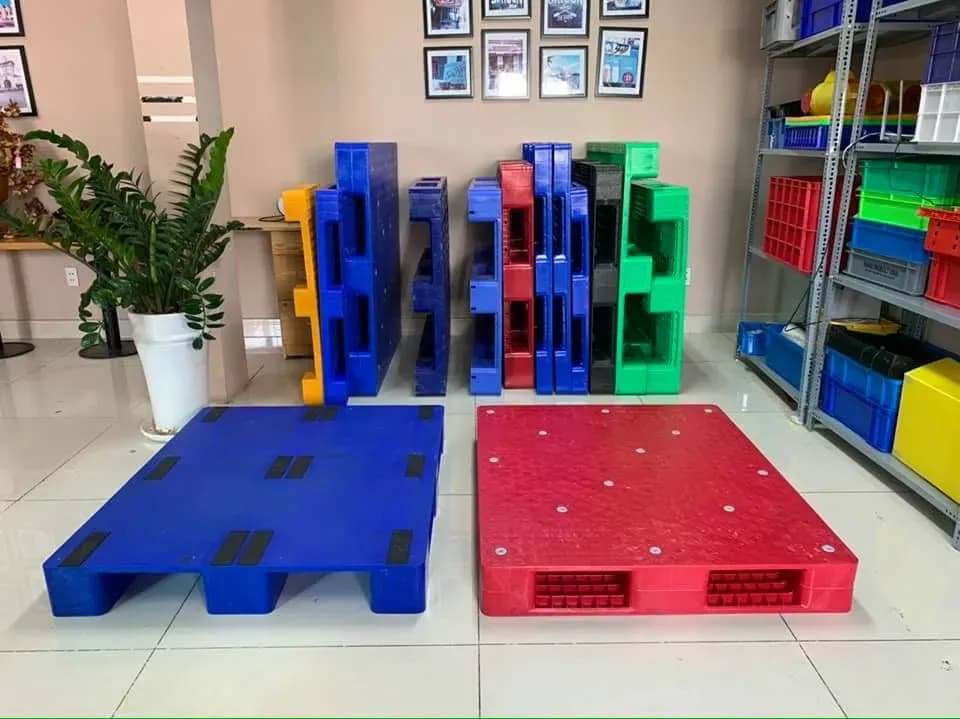
Plastic racking for goods — often called plastic pallets or floor liners — are plastic sheets placed under stacks of goods, raising them several centimeters to several inches off the floor. A simple plastic sheet solves three problems at once: blocks moisture from the floor, creates gaps for forklift forks, and keeps stacks upright without tilting.
This article discusses how to choose the right type based on your goods and warehouse operation, using real specifications of types currently sold.
1. Two Main Groups: With Legs and Without Legs
This is the first decision, depending on whether the warehouse has forklifts.
Type without legs is a flat sheet about 35 mm thick. It only lifts goods off the floor; forklifts cannot insert forks. Suitable when workers handle goods manually or use carts, for small warehouses with narrow aisles.
Type with legs has legs raising the base from 100 to 165 mm, creating clearance underneath. Manual or powered forklifts can insert forks into this gap and lift the entire stack. If the warehouse has forklifts, this type is mandatory, no exceptions.
In short: warehouses with forklifts choose the type with legs; manual handling warehouses can use the type without legs, which is sufficient and cheaper.
2. Specifications of Eight Types Currently Sold
The data below is taken from product pages, not estimates.
Group without legs, 35 mm thick
Plastic Floor Liner Pallet without Legs, Solid Surface
Dimensions 1000 × 600 × 35 mm. Static load 5,000 kg. Weight 4.5 kg, tolerance ±0.5 kg. Made of virgin or recycled HDPE. Available in blue or orange.
Plastic Pallet without Legs, Perforated Surface
Dimensions 1000 × 600 × 35 mm. Static load approximately 2,000 to 4,000 kg. Made of virgin or recycled plastic, with three grades to choose from.
Group with legs
Plastic Floor Liner Pallet with Legs
Dimensions 1000 × 600 × 100 mm. Static load from 1,000 to 2,000 kg. Perforated surface, with legs. Made of HDPE or PP. Available in blue or black.
Cross-Base Plastic Pallet
Dimensions 1100 × 1100 × 125 mm. Static load 1,800 kg, dynamic load 800 kg. Weight about 8.8 kg. Cross-base bottom. Made of virgin or recycled HDPE.
Three-Leg Plastic Pallet with Mesh Surface 1200 × 800
Dimensions 1200 × 800 × 150 mm. Static load 3,000 kg, dynamic load 1,000 kg. Weight about 10.5 kg. Mesh surface, with legs.
Three-Leg Plastic Pallet with Mesh Surface 1000 × 1000
Dimensions 1000 × 1000 × 165 mm, tolerance ±2%. Static load 3,000 kg, dynamic load 1,000 kg. Weight 12.5 kg, tolerance ±3%. Mesh surface, cup legs. Packaged one piece per carton.
Cup-Leg Plastic Pallet
Dimensions 1200 × 1200 mm. Static load approximately 6,000 kg, dynamic load approximately 2,000 kg. Mesh surface, cup legs. Made of virgin plastic. Blue color.
Specialized Type
Oil Spill Containment Plastic Pallet
Dimensions 1300 × 1300 × 300 mm. Removable mesh surface with containment compartment underneath. Available in yellow or green.
3. Static Load and Dynamic Load: Don’t Confuse These Two Numbers
This is where many buyers make mistakes.
Static load is the capacity when the pallet rests still on a flat floor. This number is always much higher.
Dynamic load is the capacity when the pallet is being moved by a forklift, with goods shaking. At this time, the entire weight is concentrated on the two fork pockets, not evenly distributed across the floor surface.
Looking at the specifications above, the difference is clear. The cup-leg pallet supports about 6,000 kg static but only about 2,000 kg dynamic, a threefold difference. The three-leg mesh pallet supports 3,000 kg static but only 1,000 kg dynamic.
Selection rule: if the warehouse has forklifts, only consider dynamic load. Choosing by static load and then loading heavy goods before forklift handling causes pallets to break inside the warehouse.
4. Mesh Surface or Solid Surface: What Are Your Goods?
These two surface types differ by whether they have drainage holes, which determines what kind of goods can be placed on them.
Choose solid surface when:
Goods are granular, powder, or small pellets that can fall through holes
You need to keep dust and debris on the surface, not falling to the floor
You want cleaning to be done by simply wiping the surface
Choose mesh surface when:
Goods are carton boxes, large bags, nothing can fall through holes
Drainage or ventilation is needed — cold storage, wet goods, goods requiring airflow
The warehouse is frequently washed down, allowing water to flow straight through
You want a lighter sheet for easier handling by staff
Granular goods placed on mesh surfaces will spill onto the floor, causing cleanup. Conversely, goods needing ventilation placed on solid surfaces will trap moisture underneath.
5. Virgin Plastic or Recycled Plastic
Most types of racking offer three grades to choose from:
Grade 1 — virgin plastic, blue color. Completely new plastic. Tough, impact resistant, less brittle in cold. Used for cold storage, food industry, export goods.
Grade 2 — recycled plastic, blue color. Used plastic ground and re-molded. Durable enough for dry warehouses at normal temperature.
Grade 3 — recycled plastic, black color. Most common grade, lowest price. Used for indoor goods with moderate load.
For the same design and size, these three grades differ significantly in price. If only storing dry goods indoors, no exposure to sun or rain, no cold storage, grade 3 is sufficient. Don’t pay virgin plastic prices for what recycled plastic can do.
6. Choose Size According to Container Door or Racking
Three common size groups and reasons for their popularity:
1000 × 600 mm — small size, suitable for narrow warehouses, tight aisles, light goods. Fits one stack of carton boxes.
1100 × 1100 mm and 1000 × 1000 mm — square size, can be rotated any direction, easy to stack on multi-tier racks.
1200 × 800 mm and 1200 × 1200 mm — large size per international standard, fits container interior. If goods are for export, choose this group from the start.
Reliable method: measure rack interior or container interior first, allow 2 to 3 cm clearance on each side, then select size. Buying first and discovering a few centimeters difference means repurchasing all.
7. Special Case: Warehouses with Oil or Chemicals
If the warehouse stores oil drums, chemical containers, or solvents, regular racking is insufficient. A leaking drum causes oil to spread on the floor, dangerous and violating fire safety and environmental regulations.
Oil Spill Containment Plastic Pallet 1300 × 1300 × 300 mm is specially made for this. The mesh surface is removable, with a sealed containment compartment underneath. Drums placed on the mesh surface will leak oil into the containment compartment, not onto the floor. After cleaning, reattach the mesh surface to continue use.
8. Tips for Durable Use
Plastic racking lasts many years if used properly. Early damage usually results from these mistakes:
Overloading beyond dynamic load. The most common mistake. See section 3.
Dragging on cement floor instead of lifting. The bottom surface wears down, legs weaken.
Prolonged sun exposure. UV rays make plastic brittle. Store indoors or under shelter.
Stacking high when empty. Stacking dozens of empty sheets causes the bottom one to bear all weight and warp gradually.
Misaligning forklift forks. Forks must enter the correct slots; misalignment breaks legs.
Cleaning is simple: spray water, scrub with mild soap, dry. Avoid strong solvents as they dull and weaken plastic.
9. Four Questions to Answer Before Ordering
Does the warehouse have forklifts? If yes, choose type with legs; if no, type without legs is sufficient and cheaper.
How heavy is one stack of goods? If forklifts are used, compare with dynamic load; if not, compare with static load.
What type of goods? Granular, powder, small debris use solid surface. Boxes, large bags, wet goods use mesh surface.
Will goods go into containers or racks? If yes, measure first then choose size; don’t choose by guesswork.
Answering these four questions narrows down to one or two correct types from the list in section 2.
Request a Quote
Minh Quân Plastic supplies all types of plastic racking mentioned, available in all three plastic grades, with nationwide delivery.
If unsure which type to choose, just tell us what goods your warehouse stores, approximate stack weight, and whether forklifts are used — we will advise the correct type before quoting. See the full plastic pallet catalog or call directly 0907 722 345.