
Waste Sorting by Bin Color: How to Use Red, Yellow, and Green Correctly
📅 Sep 7, 2026
👁 2 views
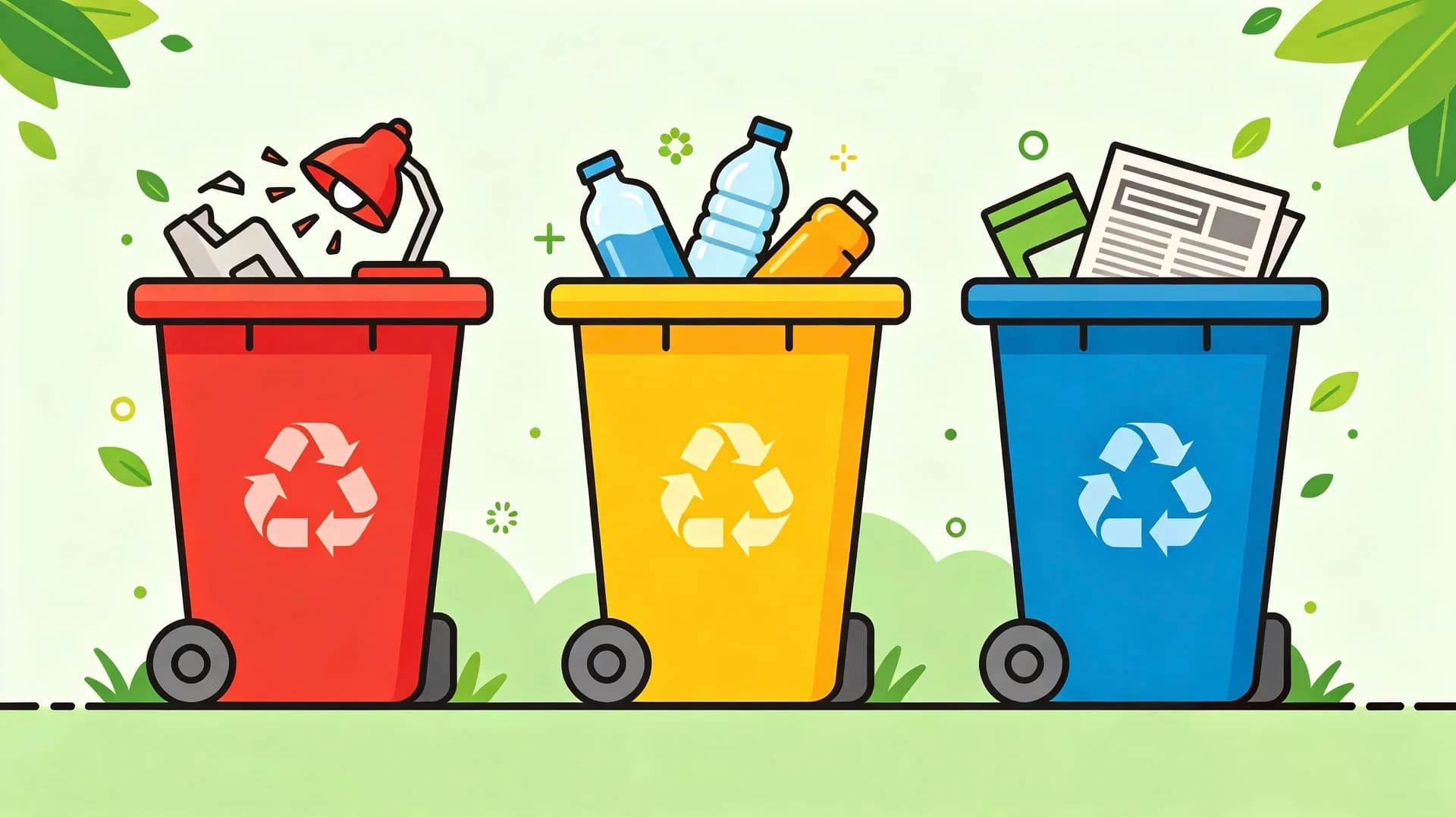
Many factories buy enough waste bins but still fail to sort waste properly. The bins are placed there, but workers still throw everything together. By the end of the day, food waste mixes with packaging, the collection unit does not accept them separately, and the money spent on bins is wasted.
The issue often lies not in awareness but in the fact that the person throwing away waste must read the text to know where to put it. The text is small and unreadable from a distance. Colors are different: visible from ten meters away, even new workers on their first day can use them.
This article clarifies three things: what the law requires about sorting, which colors should correspond to which waste types, and how to select bins by color to avoid overbuying.
1. The law requires three waste groups, but does not specify bin colors
Article 75 of the 2020 Environmental Protection Law divides household solid waste into three groups: reusable/recyclable solid waste; food waste; and other household solid waste. Source sorting is mandatory from January 1, 2025.
A common misunderstanding: the law mandates three groups but does not require any group to use a specific color. There is no clause stating food waste must go into green bins or recyclable waste into yellow bins. Bin colors are decided by the factory.
The simplest approach: finalize a single color chart for the entire factory, write it into the internal regulations, then purchase bins according to that chart. If each workshop chooses a different scheme, workers moving between areas will sort incorrectly immediately.
Before finalizing colors, ask the collection unit how they accept waste. If they only separate two groups but the factory orders four colors, all four bins will be dumped together on one truck.
2. Which color corresponds to which waste type in the factory
Below is the color coding many factories use. This is a convention, not a mandatory regulation, but following it helps workers transferred from elsewhere adapt faster.
Green — food waste, organic waste
Leftover rice, fruit peels, tea and coffee grounds, canteen waste. This group is heavy and wet; bins must be sealed to prevent leaks and flies.
Yellow or white — recyclable waste
Paper, cardboard boxes, plastic bottles, metal cans, PE pallet wrap. This group is light but bulky, so choose bins with larger capacity than other groups in the same area.
Gray or black — residual waste
Non-recyclable and non-food items: cleaning rags, dirty foam, adhesive tape, damaged protective gear.
Red — hazardous waste
Oil-soaked rags, chemical containers, batteries, fluorescent lamps, printer ink. This group is kept separately in a covered area with warning signs and handed over to authorized hazardous waste treatment units.
Red is the hardest color to find in stock. Most industrial bins default to green; other colors must be pre-ordered by quantity. For example, 120-liter foot pedal waste bins are available in green, while orange, yellow, red, blue, gray, white, and black are made to order. If all four colors are needed simultaneously, order early.
3. Medical waste has a separate color chart and must be followed exactly
Factories with medical rooms or first aid stations cannot use self-assigned color charts for waste there. Circular 20/2021/TT-BYT specifies exact colors: yellow for infectious waste, black for hazardous chemical and radioactive waste, white for recyclable waste, green for general waste.
These four colors are mandatory and cannot be changed by factory regulations. Used cotton, syringes, gloves must go into yellow bins even if the green bin next to it is empty.
Medical rooms usually do not need large bins. 15-liter medical waste bins measure 285 x 255 x 380 mm (± 10 mm), made of premium PP plastic, available in green, yellow, white, black, blue, and gray. The larger size is the 20-liter medical waste bin, measuring 350 x 330 x 450 mm (± 10 mm), same material and color range. Both sizes include yellow, black, white, and green, so buying once completes the set per the circular.
4. Comparison of three sorting methods: labeling, separate colors, divided compartments
There are three common methods, each suitable for a different layout.
Method one: buy bins of the same color then label them
Cheapest and fastest. Order a batch of green bins then apply decals to differentiate. Weakness: labels outdoors peel after months of sun and rain, text is unreadable from a distance, so mistakes still happen. Suitable for factories testing the system without heavy investment.
Method two: one bin per waste type, each a different color
Clearest and most durable. Pre-order by color; color is embedded in plastic so it does not peel. Weakness: must order quantities and wait for delivery. Suitable for factories that have finalized the color chart and know how many bins of each type are needed.
Method three: use two-compartment bins
One bin divided in two, two colors side by side, so the user immediately sees two options. 40-liter 2-compartment foot pedal bin has a total capacity of 40 liters, each compartment 20 liters, dimensions 430 x 340 x 480 mm, made of HDPE plastic, color pairs green-yellow or green-gray, with a foot pedal so no hand contact with lid. Weakness: only separates two groups and compartments are small, requiring frequent emptying.
Method two costs more initially but requires less rework. Method one often fails midway because labels get damaged and no one replaces them.
5. How to choose color and capacity by area
Not every area needs all four colors. The simple way is to see which waste types actually arise in that area.
Office, hallway, meeting room
Mainly paper and plastic bottles. Two colors suffice: one for recyclables, one for residual waste. Plastic bins with lids in multiple colors, 60 liters capacity, dimensions 400 x 400 x 600 mm, with lid and handle, available in green, yellow, orange. Upright shape fits against walls without blocking walkways.
Canteen, kitchen area
Lots of food waste, heavy and wet, must be emptied daily. Choose swing lids so tray carriers can push the lid by hand easily. 60-liter swing lid bins, dimensions 465 x 322 x 748 mm, HDPE plastic, available in green, gray, red, blue, yellow, and white — one of the few models with red in stock.
Production workshop, warehouse
Bulky waste generated each shift, need bins on wheels. 120-liter 2-wheel plastic bins, dimensions 470 x 350 x 890 mm, weight 8 kg, HDPE plastic. Larger size is 240-liter 2-wheel plastic bins, dimensions 730 x 585 x 1030 mm, weight 11 kg, with the widest available color range: green, yellow, orange, white, black, red, blue. To get a full color set without waiting for custom orders, start with this model.
Final collection point, backyard
Where waste from all areas is gathered before truck pickup, needs large capacity and must be pushable when full. 660-liter 4-wheel plastic bins, dimensions 1350 x 830 x 1110 mm, weight 43 kg, rectangular shape with lid, available in green, blue, yellow, orange. Largest is 1100-liter 4-wheel plastic bin, dimensions 1360 x 1060 x 1370 mm, weight 52 kg, green color. Both come with 12-month warranty.
Note when ordering large bins: measure passageways first. The 1100-liter bin is 1060 mm wide; if warehouse doors are narrower, it will not fit through.
6. How to place bins so workers sort correctly
Buying the right colors is only half the job. The other half is placing them correctly.
Place colors together in clusters; do not separate each color into different corners. Waste throwers stop only once; if they must look for a second bin, they will throw everything into the nearest bin.
Keep the same color order in every cluster: green on the left, yellow in the middle, gray on the right. After a few weeks, workers sort by reflex without looking.
Place bins along natural walkways, not in hidden corners. Bins far from work areas lead to careless disposal.
Attach illustrative images of waste types at eye level on the bin body. Images are more effective than text, especially for temporary workers.
Do not place hazardous waste bins mixed with regular waste clusters.
7. Tips for long-lasting sorting bins
Plastic bins usually fail not due to poor plastic but misuse. Key points from practice:
Always line bins with trash bags, even dry waste bins. Without liners, residue sticks to walls, repeated washing fades plastic color and reduces sorting effectiveness.
Outdoor bins should be made of UV-resistant plastic, e.g., 120-liter foot pedal bins made from premium HDPE with UV additives. Non-UV plastic left outdoors becomes brittle and cracks at edges.
Do not throw sharp metal waste into unlined bins. Metal shards and tin pieces tear bins, and tears spread quickly.
Pull wheeled bins by handles, do not push sideways on the body. Sideways pushing misaligns wheel axles; full 240-liter bins become hard to turn.
Do not overfill bins and force lids closed. Lid hinges are the weakest point; broken lids let rain in, making waste wet and heavier.
Wash bins with water and mild soap; avoid strong solvents. Solvents make plastic cloudy and brittle.
Buy a few extra bins of each color initially. If one breaks and no same-color replacement is available, the whole cluster will be misused within days.
Number each bin and mark its area on the body so lost bins can be returned correctly.
8. Where to start if the factory has not sorted waste yet
No need to do the whole factory at once. Trial one area first to reduce risks.
Choose the canteen or one workshop, order only two colors: one for food waste, one for residual waste. Run for a month, check how accurately workers sort and if the collection unit accepts waste separately. Then add a third color for recyclables and expand. If the color chart is not suitable, only a few dozen bins need adjustment instead of hundreds.
For capacity, simply measure daily waste volume in that area and choose bins that hold enough plus some margin. Overfilled bins cause waste to be thrown outside; bins always half empty mean overbuying. The full capacity range from 8 liters to 1100 liters is in the industrial plastic waste bin catalog.
Minh Quân Plastic supplies industrial plastic waste bins in all capacities and colors for factories, warehouses, schools, and public areas, with nationwide delivery. If you are planning sorting and need advice on which colors and capacities to choose for each area, call 0907 722 345 for a quote based on your required quantities and colors.
When calling, please prepare three pieces of information for faster service: number of areas needing bins, daily waste volume per area, and desired colors. For colors not in stock, we will specify minimum order quantities and delivery times so you can schedule accordingly.