
Closed Plastic Crates and Solid Plastic Bins: Which to Choose for Your Production Line
📅 Sep 9, 2026
👁 0 views
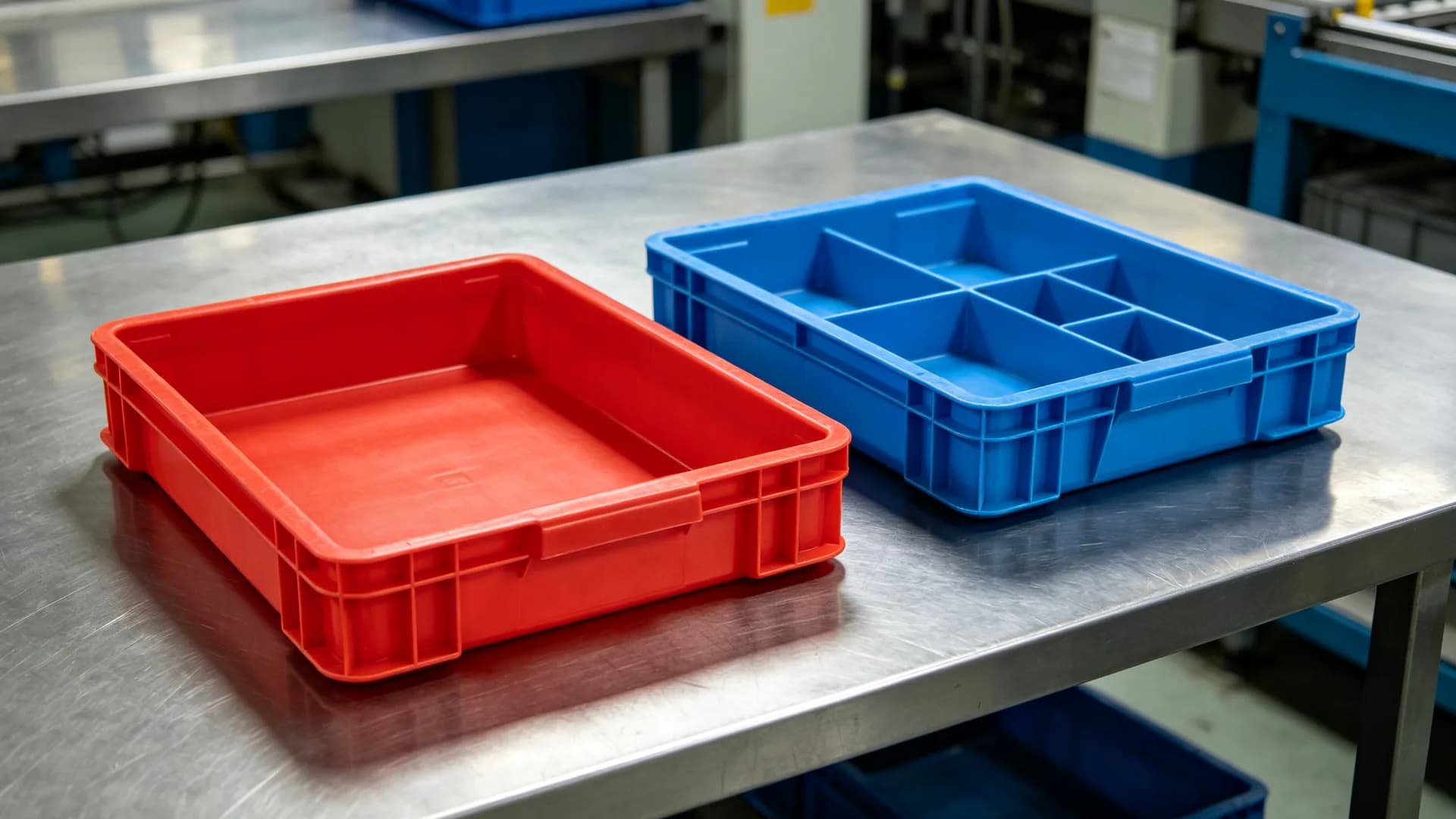
On a production line, goods do not stay in one place. Materials move from the warehouse to the line, through each stage, then to the packing and shipping area. The container travels along the entire route. Choosing the wrong type once affects the whole factory: spilled goods, workers carrying heavy loads, uneven stacking racks, and time-consuming counting.
Two groups often considered together are closed plastic crates and solid plastic bins (commonly called industrial solid plastic containers in many places). At a glance, they look similar: both have solid walls, can hold goods, and are easy to clean. But their roles on the line are very different. One suits batch goods, stackable, continuously circulated. The other suits stationary goods, large capacity, or quick manual access.
This article clarifies where the two groups differ, lists available sizes with actual measurements, explains how to select by process stage, and how to use them for durability. All data below are from Minh Quân Plastic's product pages, not estimates.
1. What are closed plastic crates and what are they suitable for
Closed plastic crates have solid walls and solid bottoms with no holes. The entire closed plastic crate line from Minh Quân Plastic is made from HDPE plastic, available in four colors: blue, red, green, and yellow, packaged one per carton.
Solid walls solve three common factory issues. First, small parts do not fall out when carrying or placing on trolleys. Second, contents inside collect less dust, especially in areas with grinding, cutting, or mechanical processing. Third, the smooth surface allows easy cleaning with water or cleaning solutions without dirt trapped in mesh gaps.
On the downside, solid walls are not ventilated. For damp goods, items needing to drain water, or where visibility inside is required, closed crates are not suitable. That is the role of open mesh crates, for example the 2T5 open plastic crate measuring 60.9 x 42.4 x 25 cm, ±0.5 cm tolerance.
2. What do solid plastic bins include
Solid plastic bins refer to a group of one-piece containers with solid bottoms that do not nest like crates. Within this group, two common types are used in factories.
Component bins with feet
Component bins with feet open at the front, have feet for stacking or mounting on wall racks. Sizes include A3, A4, A6, A8, A9, and B2, available in four colors for sorting by part or team. Sold individually or in cartons by size.
Large capacity solid plastic bins
Rectangular plastic bins have open tops, solid bottoms, made from industrial plastic, blue color, available in 50L, 100L, 200L, 500L, 750L, and 1000L sizes. Round plastic bins also have open tops and solid bottoms, available in 200L, 250L, 350L, 400L, 750L, 1000L, and 1500L; the 200L size has a top diameter of 76 cm, bottom 60 cm, height 59 cm.
3. Differences between closed plastic crates and solid plastic bins
The following four points are decisive and should be carefully considered before finalizing.
How goods move
Closed crates are designed for transport. Bottom dimensions are consistent across many sizes, allowing uniform stacking, neat pallet placement, and trolley pushing. Large solid plastic bins are mostly stationary: for filling with liquids, soaking materials, or storing raw materials waiting for the line.
How goods are picked
With crates, workers pick items from the top, so the top crate must be lifted off. Component bins with feet open at the front, allowing access to lower stacked bins without removing upper ones. For assembly lines requiring continuous picking, this is more important than capacity.
Storage capacity per use
Closed crates are sized by dimensions and internal height, with the tallest being 44.7 cm. Solid plastic bins are measured by liters, from 50L rectangular to 1500L round. For heavy or liquid goods, there is no reason to use crates.
Warehouse arrangement
Closed crates of the same bottom size stack in straight columns, easy to count and sort by color. Large solid bins require dedicated floor space, especially round types due to wider top diameter than bottom. In tight spaces, rectangular bins placed against walls save more space than round ones.
4. Available sizes of closed plastic crates
There are currently nine sizes of closed crates. The measurements below are from product pages, listed as length x width x height.
Closed plastic crate 1T: 62.6 x 42.4 x 10.2 cm, ±0.5 cm tolerance. Shallow interior, fully visible contents, suitable for small parts moving along the line.
Closed plastic crate 1T5: 62.6 x 42.4 x 15 cm, ±0.5 cm tolerance.
Closed plastic crate 1T9: 62.6 x 42.4 x 19 cm, ±0.5 cm tolerance.
Closed plastic crate 2T2: 52.3 x 43.2 x 22.3 cm, ±0.5 cm tolerance. Shorter bottom than the above three sizes, suitable for narrow spaces.
Closed plastic crate 2T5: 61 x 42 x 25 cm, with reinforcing ribs and handles on both sides.
Closed plastic crate 3T1: 61 x 42 x 31 cm.
Closed plastic crate 3T9: 61 x 42 x 39 cm.
Closed plastic crate 4T5: 77.8 x 49.6 x 44.7 cm, solid walls and bottom, with handles. Largest size in the line.
Closed plastic crate 4T5 with wheels: solid walls and bottom, equipped with wheels for pushing instead of carrying.
From this list, one practical note: three sizes 1T, 1T5, 1T9 share the same bottom 62.6 x 42.4 cm; three sizes 2T5, 3T1, 3T9 share bottom 61 x 42 cm. Purchasing within the same bottom group allows straight column stacking, keeping the warehouse neat and counting fast.
5. Selection by process stage on the production line
The quickest selection method follows the flow of goods, not the rack.
Incoming material warehouse
Goods arrive in batches, stored for long periods, rarely moved. Prioritize deep sizes to hold more in one place: 3T1, 3T9, or 4T5. Large quantities of liquid or granular raw materials use rectangular or round plastic bins sized by liters.
Preparation and distribution area
Here, sorting by item code is needed. Use medium sizes 1T9 or 2T2, one color per item group. The four colors of closed crates suffice to separate four teams or part groups without extra labeling.
On the assembly line
Choose shallow interiors so workers do not have to bend or search. Closed crate 1T at 10.2 cm height is the best size for workbenches. If workers stand fixed and pick parts continuously, component bins with feet stacked in front are faster than crates.
Transfer between factories
For long distances and heavy goods, avoid manual carrying. Closed crate 4T5 with wheels solves this. If manual carrying is still needed, choose sizes with handles like 2T5 or 4T5.
Packing and waiting for shipment
Packed goods need dust protection and high stacking. Closed crates with the same bottom size are suitable. Loose items, samples, or goods needing visibility use transparent bodies with lids, available in 15L, 30L, 55L, 90L, 120L, and 140L sizes, white transparent bodies with red side locks.
6. Calculating quantity to purchase
Do not buy based on intuition. Three numbers must be known before requesting a quote.
Quantity in circulation: count crates holding goods at all stages during one shift.
Reserve quantity: those waiting, being washed, or broken awaiting replacement.
Storage capacity by space: measure length and width of storage area, divide by bottom dimensions of intended size to know how many fit per row.
The third number is often overlooked and causes goods to arrive with no place to store. For example, a 2 m wide storage area with 61 x 42 cm bottom crates placed lengthwise fits three per row with aisle space left. Planning ahead avoids stacking blocking aisles.
7. Tips for durable use
HDPE plastic is durable, but early damage mostly results from usage, not material.
Do not drag on concrete floors. Bottom wears thin and cracks at corners. Use wheels to push if available; otherwise, carry.
Stack by bottom size correctly. Stacking 61 x 42 cm bottom crates on 62.6 x 42.4 cm crates causes misalignment, stressing walls and deforming rims.
Avoid prolonged sun exposure outdoors. Leaving crates outside all day for months makes plastic brittle and faded. Covered storage is best.
After washing, stand tilted to dry. Solid bottoms retain water; stacking immediately traps water and causes odor.
Lift by handles, not rims. Hooking and pulling rims causes cracks quickly.
Do not use crates as footrests. This happens daily in factories and breaks crate walls.
Assign colors by team from the start. Four available colors help group items without labels, which peel after washing.
8. Common mistakes when purchasing
First mistake: buying only one size for the entire factory. Assembly lines and material warehouses need different heights; forcing one size causes surplus or shortage.
Second mistake: choosing too deep a size for small parts. Goods pile at the bottom, workers must shake and search, slowing work and risking part damage.
Third mistake: forgetting to measure doors and aisles. Size 4T5 is 77.8 cm long and 49.6 cm wide, which may not fit narrow aisles or small doors, especially with wheels.
Fourth mistake: using closed crates for damp goods. Water does not drain, causing odor overnight. Open wall crates are needed in such cases.
If your goods move in batches, require stacking, dust protection, and circulation between stages, choose closed plastic crates sized by part height and storage space. If goods are stationary, measured by liters, or liquids and loose materials, choose solid plastic bins by capacity. If workers stand fixed and pick parts continuously, component bins with feet and front opening are fastest.
Minh Quân Plastic stocks nine sizes of closed plastic crates, multiple sizes of component bins, and solid plastic bins from 15L to 1500L, with nationwide delivery. If unsure which size suits your line, call 0907 722 345 for consultation and quotes based on your required quantity. Provide the type of goods stored, storage space dimensions, and quantity per shift, and we will recommend the appropriate size.