
What is a Pallet? Classification, Uses, and Common Types of Pallets Today
📅 May 20, 2026
👁 122 views
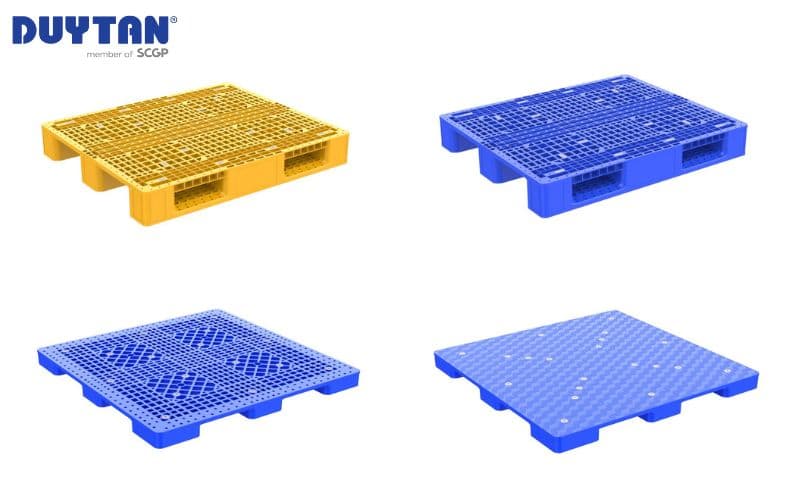
What is a Pallet?
A pallet is a type of flat structure used to support, store, and transport goods. Goods are usually placed directly on the pallet surface, then secured with stretch film, strapping, or appropriate packaging methods.
Thanks to the space underneath, pallets can be lifted and moved by hand pallet trucks, forklifts, or specialized loading equipment. Pallets help speed up the transportation process, reduce manual handling, and assist businesses in organizing warehouses more scientifically.
Today, pallets are widely used in factories, warehouses, logistics centers, supermarkets, industrial zones, import-export enterprises, and many other production sectors.
What are Pallets Used For?
Pallets have many uses in the storage and transportation of goods.
Elevating Goods from the Floor
Pallets create a gap between goods and the floor, helping to limit direct contact with dust, water, or moisture.
This function is especially important in raw material warehouses, food warehouses, manufacturing plants, and areas frequently cleaned with water.
Supporting Transportation by Forklift
The pallet’s legs and the space underneath allow forklift forks to enter and lift the entire load.
This enables businesses to move large quantities of goods at once, reducing manual labor and shortening loading times.
Organizing Warehouses Neatly
Using pallets helps divide goods by batch, product group, or storage area.
Pallets also assist businesses in arranging goods more evenly on warehouse floors, shelving systems, or inside containers.
Reducing Goods Damage
When goods are properly palletized, the risk of collisions, mold, or deformation during storage can be minimized.
Pallets also stabilize goods when wrapped with film or secured by strapping.
Optimizing Inbound and Outbound Processes
Pallets consolidate multiple boxes into a single transport unit. Warehouse staff can lift, count, and move goods by pallet instead of handling individual packages.
This contributes to improved warehouse efficiency and reduced waiting times during delivery and receipt.
Basic Structure of a Pallet
Depending on the material and intended use, pallets can have different structures. However, a typical pallet usually consists of the following main parts:
Pallet Deck
This is the part that directly contacts the goods. The deck can be designed as solid, grid, slatted, or sheet form.
The surface must have dimensions and load capacity suitable for the goods placed on top.
Pallet Legs
The legs lift the pallet surface off the ground and create space for forklift forks to enter.
Pallets can be designed with cup legs, solid legs, slat legs, cross-bottom, or no legs depending on usage needs.
Reinforcement Ribs
For plastic pallets, the underside often has multiple longitudinal and transverse ribs. This system increases stiffness, distributes load, and limits deformation during use.
Fork Entry
Fork entry is the space where forklift forks enter. Some pallets support two-way entry, while others allow four-way entry.
Businesses need to check if the pallet is compatible with the type of forklift used.
Common Types of Pallets on the Market Today
Pallets can be classified by material, structure, deck type, and intended use. The most common classification is based on manufacturing material.
1. Plastic Pallets
Plastic pallets are made from plastics such as HDPE, PP, or recycled plastic materials, depending on the product line.
This type is widely used in warehouses, factories, food, pharmaceutical, component manufacturing, garment industries, and logistics.
Advantages of Plastic Pallets
Resistant to termites.
Do not absorb moisture like wood.
Easy to clean with water.
Uniform shape and size.
Reusable multiple times.
No wood splinters or metal nails.
Suitable for various warehouse environments.
Available in multiple colors for goods classification.
Limitations of Plastic Pallets
Initial cost may be higher than some wooden pallets.
Repairing cracks or deformation is usually more difficult than wood pallets.
Should not exceed the declared load capacity.
Material selection must match environment and usage purpose.
Common Types of Plastic Pallets
Plastic pallets are divided into various types such as:
Plastic grid deck pallets.
Plastic solid deck pallets.
Plastic cup leg pallets.
Plastic cross-bottom pallets.
Plastic no-leg pallets.
Plastic floor liner pallets.
Plastic oil spill resistant pallets.
Plastic pallets for forklifts.
At Minh Quân Plastic, plastic pallets can be classified by material as follows:
Type 1 Pallet: virgin green plastic.
Type 2 Pallet: recycled green plastic.
Type 3 Pallet: recycled black plastic.
Each type suits different budgets, environments, and usage requirements.
2. Wooden Pallets
Wooden pallets are made from wooden slats joined by nails or suitable fastening methods.
This traditional type is commonly used in goods transportation, import-export, and industrial warehouses.
Advantages of Wooden Pallets
Relatively reasonable initial investment cost.
Easy to customize size as required.
Individual slats can be repaired or replaced.
Suitable for many types of goods.
Widely available supply.
Limitations of Wooden Pallets
Susceptible to termites, mold, or rot.
Prone to wood splinters and nails.
Harder to clean than plastic pallets.
Quality may vary between pallets.
May require treatment according to regulations for export use.
Longevity depends heavily on storage environment.
Wooden pallets suit businesses needing cost-effective pallets, easy repair, or limited transport cycles.
3. Paper Pallets
Paper pallets are usually made from carton, honeycomb paper, or multilayer pressed paper.
This type is lightweight and often used for light goods, one-way transport, or orders requiring reduced packaging weight.
Advantages of Paper Pallets
Lightweight.
Easy to handle and transport.
No nails or wood splinters.
Suitable for light export goods.
Convenient disposal after use.
Can be designed to custom sizes.
Limitations of Paper Pallets
Limited water and moisture resistance.
Not suitable for heavy goods.
Lower reuse capability than plastic pallets.
Prone to deformation if stored in unsuitable environments.
Paper pallets are often used for electronics, lightweight products, carton-packed goods, and one-way transport.
4. Metal Pallets
Metal pallets are usually made from steel, iron, or aluminum. This type has a sturdy structure and suits heavy goods or special usage environments.
Advantages of Metal Pallets
High load capacity.
Robust structure.
Suitable for heavy goods.
Long lifespan when used properly.
Can be used in specialized warehouse systems.
Good impact resistance.
Limitations of Metal Pallets
Heavy weight.
High initial investment cost.
May corrode if material or coating is unsuitable.
Manual handling is more difficult.
Not necessary for many common goods.
Metal pallets are often used in mechanical engineering, automotive, machinery manufacturing, mold making, and sectors with heavy load goods.
5. Composite Pallets
Composite pallets are made from composite materials, combining plastic with fibers or other reinforcing components.
This type usually targets specific requirements for load capacity, durability, or usage environment.
Advantages of Composite Pallets
Relatively stable structure.
Good moisture resistance.
Can be designed to technical specifications.
Suitable for certain specialized industrial environments.
Limitations of Composite Pallets
Potentially high cost.
Less common than plastic and wooden pallets.
Difficult to repair when damaged.
Technical specifications must be clearly verified before use.
Classification of Pallets by Structure
Besides material, pallets are also classified by shape and construction.
Two-Way Entry Pallets
Two-way entry pallets allow forklift forks to enter from only two opposite sides.
This design is usually simple but offers less warehouse access flexibility than four-way entry pallets.
Four-Way Entry Pallets
Four-way entry pallets allow forklift access from all four sides.
This type is more flexible during loading, especially in warehouses with limited space or narrow aisles.
Single-Sided Pallets
Single-sided pallets have only one main surface for placing goods and usually cannot be flipped for use.
This is a common structure for many plastic cup leg pallets and floor liner pallets.
Double-Sided Pallets
Double-sided pallets have similar construction on both top and bottom surfaces.
This type can distribute load well under certain conditions but is usually heavier.
Grid Deck Pallets
Grid decks have many ventilation slots that allow water drainage, reduce weight, and facilitate cleaning.
Grid deck pallets suit cold storage, food factories, and areas requiring frequent cleaning.
Solid Deck Pallets
Solid deck pallets have a closed or nearly closed surface, suitable for bagged goods, small boxes, or products needing a flatter support surface.
Differences Between Plastic and Wooden Pallets
Plastic and wooden pallets are the two most commonly used types today.
Moisture Resistance
Plastic pallets are less affected by water and humidity. Wooden pallets can absorb moisture, mold, or rot if not stored properly.
Hygiene
Plastic pallets are usually easier to clean because their surfaces are waterproof. Wooden pallets have gaps, wood grain, and nail points, making thorough cleaning more difficult.
Weight
Weight depends on design. Some plastic pallets are lightweight and uniform, while wooden pallets vary by wood type and moisture content.
Repair
Wooden pallets allow replacement of individual slats when damaged. Plastic pallets are harder to repair if cracked or structurally broken.
Uniformity
Plastic pallets are molded, so dimensions are usually consistent. Wooden pallets may have variations due to raw materials and processing.
Cost
Wooden pallets generally have lower initial investment costs. Plastic pallets may be more expensive but suit repeated reuse and hygienic environments.
Which Type of Pallet Should You Choose?
There is no one-size-fits-all pallet. Businesses should base their choice on goods characteristics and operational processes.
Choose Plastic Pallets When
Multiple reuse is needed.
The environment is humid.
Frequent cleaning is required.
Uniform dimensions are desired.
Color-coded pallet classification is needed.
Used in clean factories or warehouses.
Want to avoid termites and wood splinters.
Choose Wooden Pallets When
Initial investment cost optimization is desired.
Custom size fabrication is needed.
Simple repairs are required.
Used for one-way transport.
Frequent water cleaning is not required.
Choose Paper Pallets When
Goods are lightweight.
Reducing transport weight is important.
Single or low reuse cycles.
Dry environment.
No water exposure.
Choose Metal Pallets When
Goods have high load capacity.
High stiffness and durability are needed.
Used in mechanical or machinery industries.
Budget allows for investment.
Operating environment requires sturdy construction.
Criteria to Check When Purchasing Pallets
Before ordering pallets, businesses should check the following factors:
Load Capacity
Clearly determine static load, dynamic load, and racking load if applicable.
Do not use static load alone to assess forklift lifting capability.
Dimensions
Pallet size must fit goods, shelving systems, forklifts, containers, and warehouse space.
Material
Pallet material should suit the environment, hygiene requirements, and budget.
Deck Type
Grid decks suit drainage and cleaning needs. Solid decks suit goods with small bases or requiring flat support.
Leg Type
Check if leg type is compatible with hand pallet trucks, forklifts, and shelving systems.
Usage Environment
Temperature, humidity, chemicals, floor surface, and outdoor conditions can affect pallet lifespan.
Reuse Cycles
If pallets are used continuously in internal cycles, prioritize durable and easy-to-clean products.
If pallets are for one-way use, lower-cost options may be chosen.
Common Mistakes When Using Pallets
Some errors that can cause pallet damage or safety risks include:
Loading beyond load capacity.
Concentrating the entire load on one point.
Using pallets incompatible with forklifts.
Incorrect fork insertion position.
Dragging pallets over sharp surfaces.
Dropping pallets from height.
Uneven stacking of goods.
Using cracked or deformed pallets.
Placing pallets on sloped or uneven floors.
Not inspecting pallets before use.
How to Maintain Pallets for Longer Use
To extend pallet lifespan, businesses should:
Use within load capacity.
Distribute goods evenly.
Clean regularly.
Place pallets on flat surfaces.
Avoid strong impacts.
Keep pallets away from high heat sources.
Separate damaged pallets from use areas.
Stack pallets neatly when empty.
Regularly inspect legs and reinforcement ribs.
Train forklift operators on proper handling.
Role of Pallets in Logistics Operations
In logistics, pallets help standardize goods units and shorten loading times.
Instead of moving individual boxes, businesses can consolidate multiple packages on one pallet. The entire palletized load is then wrapped, secured, and lifted by forklift.
Using pallets also helps:
Facilitate goods counting.
Reduce manual handling.
Optimize container space.
Speed up inbound and outbound processes.
Ease shelving arrangement.
Reduce risk of goods contacting the floor directly.
Support batch management.
Conclusion
Pallets are an important part of storage, stacking, and goods transportation. The market currently offers many types such as plastic, wooden, paper, metal, and composite pallets.
Among these, plastic pallets are chosen by many businesses due to moisture resistance, ease of cleaning, uniform size, and multiple reuse capability. However, businesses should select products based on load capacity, dimensions, leg type, lifting equipment, and actual usage environment.
Minh Quân Plastic provides various plastic pallet models including grid deck, solid deck, cup leg, no-leg, and floor liner pallets with diverse sizes, materials, and load capacities.
Customers needing bulk orders or price quotes can contact Minh Quân Plastic for detailed consultation.