
Plastic Pallets or Wooden Pallets: The Cost Equation for Warehouses
📅 Sep 21, 2026
👁 0 views
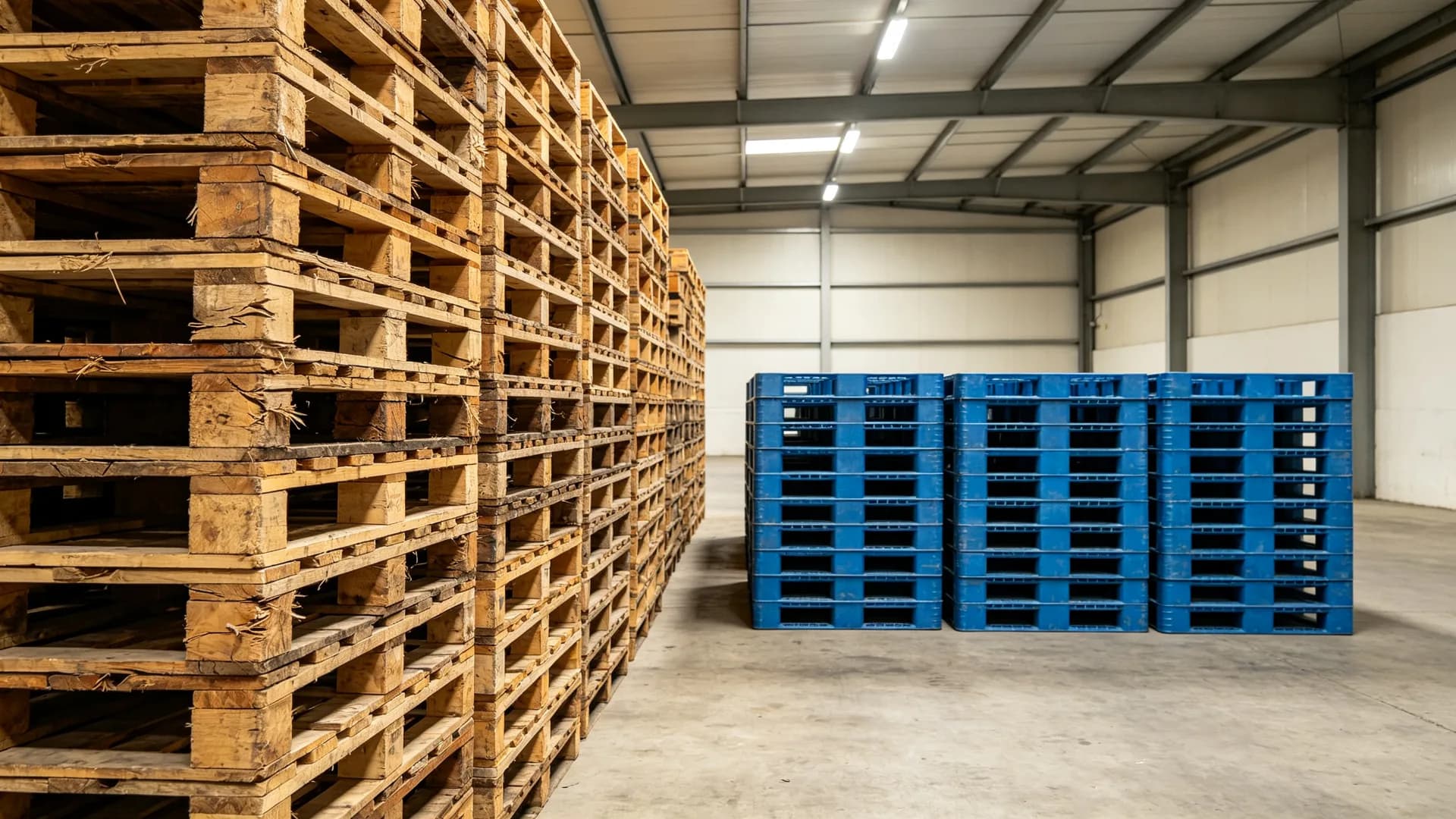
Each time a warehouse needs to replenish pallets, the old question returns: buy wooden pallets for lower cost or switch entirely to plastic pallets? At first glance, the initial invoice usually shows wood is cheaper. But after a few months of operation, the number of pallets with broken legs, popped nails, and mold increases, and the initial "cheap" cost is no longer cheap.
The issue is most places only compare purchase prices. The real cost of a pallet also includes the number of replacements, repair labor, damaged goods due to pallets, and risks when exporting goods. Missing these items skews any calculation.
This article places plastic pallets and wooden pallets side by side from the warehouse cost perspective: where to compare, how to calculate, when to keep wood, when to switch to plastic, and how to choose the right plastic pallet type. The specifications mentioned are taken directly from product pages for you to input into your own spreadsheets.
1. Why comparing purchase price alone is insufficient
Pallets are bought once but used daily, subjected to forklift impacts, stacking, washing, and exposure to sun and rain outdoors. Their lifespan determines cost, not the price on the quote.
A fairer calculation is to convert to cost per year of use: divide purchase price by the number of years the pallet remains usable, then add repair costs and product loss. By this method, a more expensive pallet that lasts many times longer often proves more economical.
There is also a rarely recorded cost: downtime each time a pallet breaks mid-shift.
2. Comparing plastic and wooden pallets on cost-impacting factors
Durability and replacement frequency
Wood has good initial strength but fails cumulatively: cracked boards, popped nails, rotted legs. Frequent repairs reduce load capacity. Plastic pallets are molded in one piece without nailed joints, so no places to pop; damage is usually cracking from strong impacts rather than gradual deterioration.
Moisture, termites, and mold
This is where wood clearly loses in southern climates. Wood absorbs moisture, becomes heavier, molds easily, and attracts termites. HDPE and PP plastics resist termites, do not rot, and are less affected by high humidity. Cold storage, processing, and washing areas show this difference immediately.
Hygiene
Wooden pallets are very difficult to clean thoroughly; water soaks into the grain and remains. Plastic pallets can be pressure washed and dry quickly. For food, pharmaceutical, and seafood goods, this is not just convenience but a mandatory inspection requirement.
Safety for goods and personnel
Wood splinters and protruding nails tear packaging, scratch cartons, and injure workers. Plastic surfaces are seamless, without nails or splinters.
Weight and handling labor
Plastic pallets are lightweight and have stable weight, unaffected by moisture. Weight is clearly stated per model: floor liner type without legs and solid top weighs 4.5 kg ±0.5 kg, cup-leg type weighs 6.5 kg ±5%, cross type weighs about 8.8 kg. Accurate weighing enables precise freight cost calculation.
Export goods
Wooden pallets exported abroad must undergo quarantine treatment per ISPM 15 standards, with stamps and documentation. Plastic pallets are exempt. For warehouses with export goods, this is a recurring cost difference per shipment.
3. Commonly overlooked costs when making calculations
When putting plastic and wooden pallets in the same spreadsheet, include these lines, not just purchase price:
Number of pallets replaced annually, separately for each type.
Wood pallet repair labor: reattaching boards, removing nails, replacing legs.
Damaged goods due to pallets: torn packaging, crushed boxes, spilled goods.
Quarantine treatment costs if goods are exported.
Storage and disposal costs for damaged pallets.
Downtime each time a pallet breaks mid-shift.
Occupational accident risks from splinters and nails.
After completing this table, many warehouses find the cost difference lies in "replacement frequency" rather than purchase price. This explains why two warehouses in the same industry reach different conclusions: warehouses with high pallet turnover clearly benefit from plastic, while those storing pallets under goods for months see a narrower gap.
4. Plastic pallet specifications for calculations
This section lists actual specifications of available models for you to compare with your load and size requirements.
Legged types for forklifts
Plastic cup-leg pallet: dimensions 1000 x 1200 x 140 mm, grid top, virgin plastic, static load about 6,000 kg, dynamic load about 2,000 kg, weight 6.5 kg ±5%.
Plastic 3-leg pallet: dimensions 1200 x 800 x 150 mm, grid top with lifting legs, virgin or recycled HDPE plastic, static load 3,000 kg, dynamic load 1,000 kg, weight about 10.5 kg.
Plastic cross pallet: dimensions 1100 x 1100 x 125 mm, cross bottom, virgin or recycled HDPE plastic, static load 1,800 kg, dynamic load 800 kg, weight about 8.8 kg.
Plastic 9-leg pallet: dimensions 1200 x 800 x 140 mm, 9 cup legs arranged 3 rows x 3 columns, virgin or recycled PP plastic, forklift accessible from all four sides. Load rating depends on plastic type and stacking method, so consult technical department before finalizing.
Plastic legged pallet with perforated top: dimensions 1000 x 600 x 100 mm, HDPE or PP plastic, static load from 1,000 kg to 2,000 kg, blue or black color.
Floor liner types without legs
Plastic floor liner pallet without legs, solid top: 1000 x 600 x 35 mm, virgin or recycled HDPE plastic, static load 5,000 kg, weight 4.5 kg ±0.5 kg, blue color.
Plastic floor liner pallet without legs, perforated top: 1000 x 600 x 35 mm, virgin or recycled plastic, static load about 2,000 to 4,000 kg, black color.
Chemical area type
Oil spill containment plastic pallet measures 1300 x 1300 x 300 mm, grid top detachable with containment compartment underneath to catch oil, liquids, or chemical leaks. Yellow color with optional blue. Wooden pallets cannot perform this function in chemical warehouses.
The two load ratings, static and dynamic, are not interchangeable. Static load is when the pallet is stationary; dynamic load is when moved by forklift. Stacking by static load then running forklifts is the fastest way to break pallets.
5. When to keep wooden pallets
Not every warehouse needs to switch. Wood remains reasonable in cases:
One-way pallets, delivered and left at the receiver, not returned to warehouse.
Goods with unusual dimensions requiring custom-sized pallets.
Dry warehouses, light goods, pallets rarely moved.
Budget only sufficient for immediate purchase and no long-term plan.
Many warehouses use both: plastic for internal turnover and humid areas, wood for one-way deliveries. This keeps investment cost acceptable while addressing the most failure-prone areas.
6. How to choose the right plastic pallet for your warehouse
Answer these five questions to find the model to buy.
How heavy is the load and does the pallet need to be moved?
If forklifts lift loaded pallets, consider dynamic load rating. Weigh the actual load, add a safety margin, then select a model with dynamic load rating above that number.
Fixed stacking or rack storage?
If stacking directly on the floor without forklifts, floor liner type without legs suffices, only 35 mm high so almost no height impact. If forklifts are used, choose legged types to allow fork entry.
Grid top or solid top?
Grid top drains water quickly, is lighter, suitable for washing areas and cold storage. Solid top prevents small items from falling through, suitable for loose goods, bagged goods, and soft-bottomed items.
Dimensions matching racks and forklifts
Measure internal rack dimensions before selecting. European standard warehouses commonly use 1200 x 800 mm; square stacking warehouses prefer 1100 x 1100 mm for easier rotation. 1000 x 600 mm suits narrow aisles and small goods.
Plastic type
Virgin plastic is more durable and consistent, suitable for food and heavy long-term loads. Recycled plastic costs less, suitable for lining and internal circulation. See also plastic pallet catalog for other models.
7. Tips for long-lasting plastic pallet use
Plastic pallets are durable but still fail if misused. The following points extend lifespan without extra cost:
Do not exceed dynamic load when forklifts lift loaded pallets.
Insert forklift forks fully, do not lift by fork tips. This is the most common cause of leg cracks.
Distribute load evenly on pallet surface, avoid concentrating weight on one corner.
Do not drag pallets on rough concrete; lift and set down instead.
Stack empty pallets straight, not tilted or too high.
After washing, dry before stacking to avoid water trapped between pallets.
Do not expose pallets continuously to strong sunlight when not in use; cover to maintain plastic flexibility longer.
Separate cracked pallets; do not mix with batches used for heavy goods.
8. Common mistakes when switching from wood to plastic
The first mistake is buying by price without checking load rating, causing pallets to sag under load. The second is applying wooden pallet dimensions directly to plastic without measuring rack internal size. The third is switching the entire warehouse at once instead of trialing a small batch in the heaviest area for a few weeks before scaling up.
Trial runs are the most worthwhile step. A small batch placed in the most failure-prone spot will show if the chosen model is adequate.
9. Conclusion
If the warehouse handles heavy goods with continuous turnover, has humid areas, cold storage, food products, or export goods, plastic pallets usually prove more economical when calculated per year. If pallets are mainly one-way and left behind, or goods are light and warehouse dry, wood remains reasonable. Most warehouses fall in between and use both types.
Minh Quân Plastic Co., Ltd supplies industrial plastic pallets with nationwide delivery. Send your goods dimensions, weight per unit, rack internal size, and forklift usage method; we will advise suitable models and provide quotes by quantity. Call 0907 722 345 for direct support.