
How Much Load Can Plastic Pallets Withstand? Understanding Static and Dynamic Load Ratings
📅 Sep 18, 2026
👁 0 views
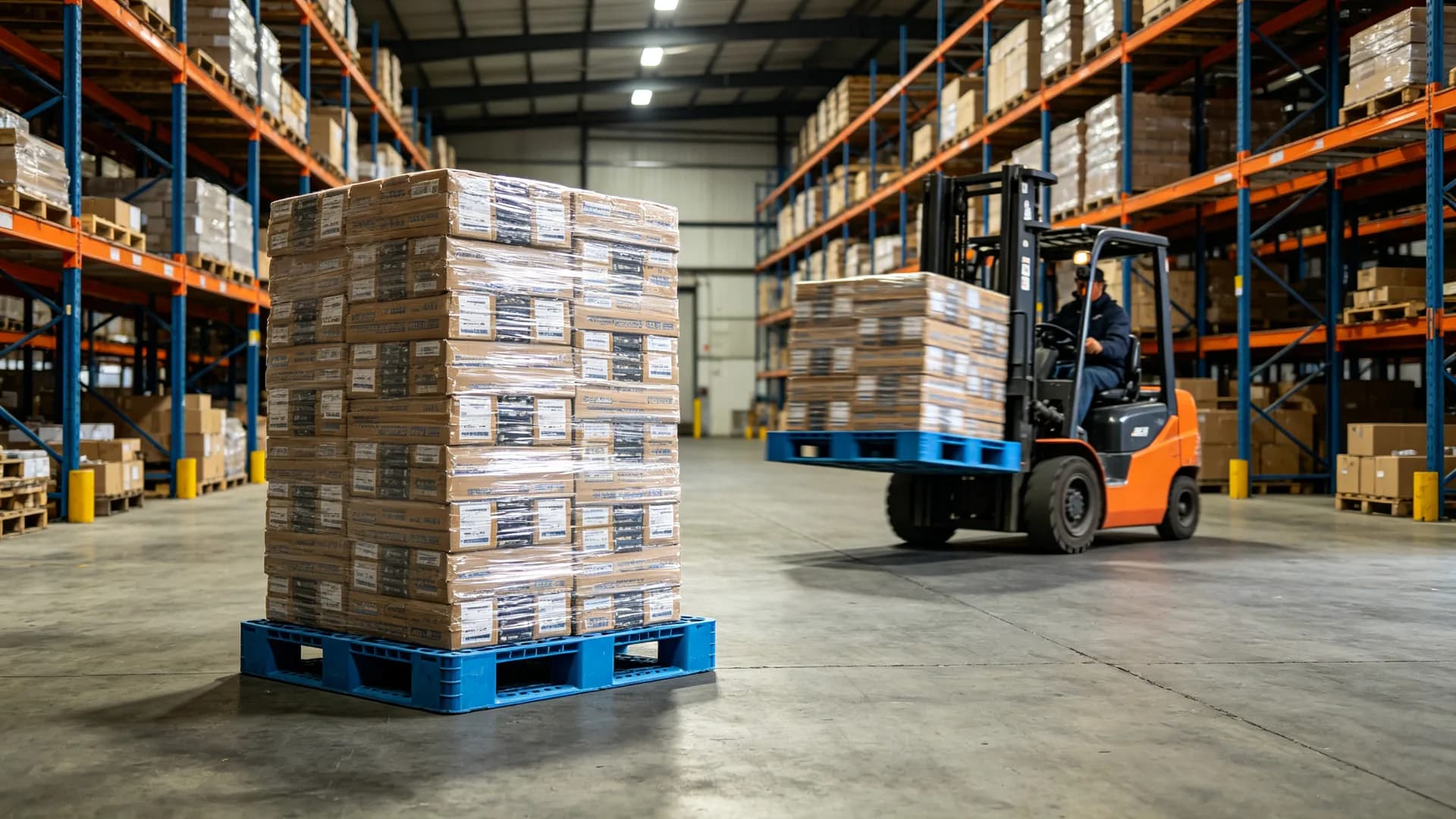
The most common question when buying plastic pallets is "how many kilograms can this type withstand?" The seller gives a number, the buyer notes it down and places an order. A few months later, the pallet sags in the middle, cracks at the legs, or breaks just as the forklift withdraws its forks. Upon rechecking, the initial number was not wrong. It just referred to a different situation than how the warehouse uses it.
The load rating of plastic pallets is not a single number. It is three numbers corresponding to three ways the goods rest on the pallet: lying still on the floor, being lifted by a forklift, and supported at both ends on rack beams. These three scenarios bear very different forces. A pallet marked 3,000 kg when placed on the floor only bears 1,000 kg when lifted by a forklift. The same product, the same specification sheet.
This article explains those three numbers, compares them with the actual specifications of pallet lines currently sold, and then shows how to translate warehouse cargo into the type to buy.
1. What is the load rating of a plastic pallet?
Load rating is the maximum cargo weight a pallet can bear under a specific condition. The latter part is the important one and often overlooked.
The same pallet, placed on a flat concrete floor, is supported across its entire bottom surface, distributing the force evenly. When lifted by a forklift, only the two forks support it, concentrating the force on two narrow strips. When placed on racks, only the two edges have support points, with the middle suspended in the air throughout storage.
Therefore, the specification sheet separates three lines:
Static load — cargo lying still on a flat surface, pallet fully supported underneath.
Dynamic load — pallet being lifted or moved by forklift or pallet truck, with vibrations.
Rack load — pallet supported at both ends on beams, with the middle unsupported.
These three numbers decrease in that order. The static load number is always the largest and is often given first. If the warehouse uses forklifts, that is not the number to focus on.
2. Static load: the largest number, most often misunderstood
Static load applies to only one situation: the pallet lies on a flat floor, cargo stacked on it, and no one touches it. Dry warehouses stacking bags, raw material warehouses piled up, and areas with moisture-proof floor lining are places where this number truly matters. The plastic floor liner pallet without legs, solid top is only 35 mm thick, weighs 4.5 kg (±0.5 kg), but has a static load rating of 5,000 kg. A thin plastic sheet can bear five tons because it rests on the floor, with the entire bottom surface supported by concrete, so the plastic mainly endures compression rather than bending.
With the same dimensions 1000 x 600 x 35 mm, the plastic floor liner pallet without legs, perforated top has a static load rating of about 2,000 kg to 4,000 kg. The perforated top allows better ventilation and drainage but has less solid plastic, so the number is lower.
Note: both floor liner types have no legs and no space for forklift forks to enter. The 5,000 kg figure is for stacking cargo, not for lifting.
3. Dynamic load: the decisive number when forklifts operate
Dynamic load is the maximum cargo weight when the pallet is lifted and moved. At this time, only the two forklift forks support the pallet, plus vibrations when the forklift passes expansion joints in the floor, brakes suddenly, or lifts and lowers. Vibrations generate forces greater than static weight, so the dynamic load number is always lower.
Comparing lines that provide both numbers:
3-leg plastic pallet: static 3,000 kg, dynamic 1,000 kg.
3-leg plastic pallet with mesh top: static 3,000 kg, dynamic 1,000 kg.
Plastic pallet with cup legs: static about 6,000 kg, dynamic about 2,000 kg.
Cross-shaped plastic pallet: static 1,800 kg, dynamic 800 kg.
These four lines show a rule: for products listing both numbers, the dynamic load is about one-third of the static load. The cross-shaped pallet is slightly higher, 800 compared to 1,800.
Therefore, warehouses with forklifts or pallet trucks, or cargo loading/unloading containers, should use the dynamic load as the standard. A 1,500 kg cargo moved by forklift cannot use a 3-leg pallet with a dynamic load of 1,000 kg, even if the static load is 3,000 kg.
4. Rack load: the most demanding case
This is the least mentioned number but causes the most damage. When the pallet rests on two selective rack beams, only the two edges have support points, with the middle suspended in the air for months.
Plastic has creep characteristics: under continuous bending force over a long time, the pallet sags gradually and does not return to its original shape, even if the load is below the breaking threshold. Excessive sagging causes cargo to tilt or the pallet to slip off the beam. Warehouses without insulation, exposed to hot midday sun, cause plastic to soften and creep faster.
The specification sheets of pallet lines currently on the site do not list rack load. If the warehouse uses selective racks, this number must be clarified before ordering, along with the distance between the two beams. Using dynamic load instead of rack load is unsafe.
5. Comparing load ratings of plastic pallet lines currently sold
Specifications of each line in the industrial plastic pallet group, arranged by intended use.
Floor liner group, no forklift lifting
Floor liner without legs, solid top: 1000 x 600 x 35 mm, virgin or recycled HDPE plastic, blue color, weighs 4.5 kg (±0.5 kg), static load 5,000 kg.
Floor liner without legs, perforated top: 1000 x 600 x 35 mm, virgin or recycled plastic, black color, static load about 2,000 kg to 4,000 kg.
Light cargo support group, with legs
Plastic pallet with legs, perforated top: 1000 x 600 x 100 mm, HDPE or PP plastic, blue or black color, static load from 1,000 kg to 2,000 kg.
Cross-shaped plastic pallet: 1100 x 1100 x 125 mm, virgin or recycled HDPE plastic, blue color, weighs about 8.8 kg, static load 1,800 kg, dynamic load 800 kg.
Forklift handling group
3-leg plastic pallet: 1200 x 800 x 150 mm, virgin or recycled HDPE plastic, blue color, weighs about 10.5 kg, static load 3,000 kg, dynamic load 1,000 kg.
3-leg plastic pallet with mesh top: 1000 x 1000 x 165 mm (±2%), weighs 12.5 kg (±3%), static load 3,000 kg, dynamic load 1,000 kg. Three material options: type 1 virgin green plastic, type 2 recycled green plastic, type 3 recycled black plastic.
Heavy load group
Plastic pallet with cup legs: 1200 x 1200 mm, 150 mm high, virgin plastic, blue color, static load about 6,000 kg, dynamic load about 2,000 kg. This is the highest load line among those with legs, thanks to the mesh top combined with cup leg system distributing force more evenly.
6. How to choose a pallet according to the warehouse's actual load
Step 1: Weigh a fully loaded cargo
Weigh an actual fully loaded cargo as stored, including goods, container, and shrink wrap. For multiple types of goods, use the heaviest cargo as the standard, not the average.
Step 2: Determine where the pallet will be placed
Lying still on the floor, goods picked by hand or trolley: consider static load.
Forklift or pallet truck passes through: consider dynamic load.
On selective racks: ask for rack load before ordering.
If a pallet passes through multiple scenarios, use the most demanding case as the standard.
Step 3: Allow a safety margin
Do not choose a pallet with a load rating exactly equal to the cargo weight. Goods rarely stack perfectly balanced, warehouse floors are rarely perfectly flat, and forklift drivers sometimes rush. Choosing a pallet with a load rating higher than the heaviest cargo is the least costly way to avoid mid-use damage.
Step 4: Check dimensions before finalizing
Correct load rating but wrong dimensions still require repurchasing. Measure cargo, aisle width, and forklift fork spacing. Available sizes include 1000 x 600 mm, 1200 x 800 mm, 1000 x 1000 mm, 1100 x 1100 mm, and 1200 x 1200 mm. Goods must not overhang the pallet edges, as overhang concentrates force on edges and causes cracking.
7. Misunderstandings causing early pallet breakage
Using static load to calculate lifting capacity. The most common and costly mistake. The difference between the two numbers in lines listing both is about three times.
Stacking loaded pallets on top of each other. The bottom pallet bears the weight of upper layers through a few small contact points, not the entire surface. This situation easily cracks legs.
Using perforated top pallets for small bags or loose goods. This is a contact issue, not load rating. Small bags sink into holes, bag bottoms get pinched and torn. Such goods should use solid top pallets.
Assuming types 1, 2, and 3 differ only in color. Virgin green plastic, recycled green plastic, and recycled black plastic differ in material properties. For heavy goods, price differences between types are usually less than the cost of early pallet replacement.
8. Tips for long-lasting plastic pallets
Stack cargo in the center of the pallet. Heavy cargo in the middle, lighter cargo outside, keeping goods within pallet edges. This alone extends pallet life without extra cost.
Insert forklift forks fully. Inserting halfway then lifting is the fastest way to break pallets, as weight concentrates at the fork tips. Remind drivers to insert fully and lift/lower slowly.
Avoid prolonged sun exposure and dragging on rough floors. Outdoor exposure causes plastic to become brittle and fade due to UV rays. Dragging wears legs and edges, especially on floors with metal debris — lift and set down, do not push.
Inspect regularly and retire early. Check monthly. Pallets with cracked legs, obvious sagging, or chipped edges should be separated for light-duty use or discarded. A pallet breaking while carrying cargo causes much greater damage than the pallet cost.
In summary, choosing plastic pallets does not start with finding the largest number but by determining whether the pallet will lie still, be lifted, or placed on racks. Choose the correct load rating line corresponding to the heaviest cargo in the warehouse, then check dimensions and top type.
Minh Quân Plastic supplies industrial plastic pallets in various sizes and load ratings, delivering nationwide. If you hesitate between two lines or are unsure which load rating your warehouse needs, just describe the heaviest cargo, handling method, and rack type. We will compare with each line's specifications and recommend the suitable type with a quotation by quantity. Call 0907 722 345 for consultation. If you want to see actual samples before deciding, please notify us in advance so we can prepare samples.